Showing posts with label SRM Sections. Show all posts

Wednesday, July 27, 2011

New Mexico Summer Tour

By Les Owen, New Mexico Section

The New Mexico Section of the Society for Range Management held its Summer Tour on July 22, 2011 at the NMSU Corona Range and Livestock Research Center. Ranch Superintendent, Shad Cox, started the day off with an overview of operations on the 42 section ranch located in central New Mexico. The CRLRC is a unique research facility in that research and ranch operations are funded by commercial livestock production (cattle and sheep) and hunting opportunities on the ranch. A large collection of research literature is available on the CRLRC website.

The first stop was in a pasture where juniper was mechanically controlled in the late 1970s. Dr. Andrés Cibils is leading a research project using very large scale aerial photography and specialized software to analyze re-invading juniper sapling density effects on grass production. Preliminary data indicate that when sapling size reaches 1 meter cover, grass production decreases significantly.

Stop 2 was in a pasture where roughly half was open grassland and half juniper woodland. GPS collars were fitted on cattle and mule deer to determine habitat preference for each species based on tree densities, time of year, and climatic conditions. Data show that both mule deer and cattle start to avoid woodland areas when canopy cover exceeds 40%.

The third site was an area where an intensive targeted grazing study was conducted using goats and sheep to control juniper saplings. Results only indicated a 5% kill on saplings, with most controlled individuals being smaller in size. The majority of the saplings were too large and established for the targeted grazing to be highly effective. Targeted grazing can be an effective tool for managing juniper saplings that are small and could be a good complementary tool with other control mechanisms.

Just before lunch we visited a half section pasture where re-invading juniper was controlled using individual plant treatments of Velpar. Around 95% control was achieved for close to $9.50 per acre application cost. The CRLRC employed the services of the NMSU Range Club to apply the treatment which resulted in good experience for the students and an effective control for the CRLRC. Tour Sponsor and DuPont Representative, Jack Lyons, provided information about placement of soil application of Velpar in relation to the edge of the juniper drip line.

Lunch was served at the almost completed Southwest Center for Rangeland Sustainability located near the center of the ranch. Shad Cox provided a tour of the new facility which will serve as a centrally located venue in New Mexico for educational programs related to agriculture. The facility houses a classroom, conference room, offices, and a commercial kitchen. Look forward to hearing of many more great programs being hosted at this facility.

After lunch we moved on to a site where individual juniper plants in plots received either a foliar application of Surmount or tree drip line application of Tordon. Tour Sponsor and Dow Representative, Greg Alpers, provided information about the applications and emerging technology using electrostatically charged herbicide to vastly improve efficacy of aerial treatments. Trials have been conducted on mesquite and cholla with promising results.

Next a research project using VLSA photography to estimate juniper biomass for use as a biofuel was visited. After the photography was acquired, each juniper was individually harvested, mulched and weighed to calibrate the estimation tool. This was done on two separate plots where about 50 tons of biomass was harvested. Researchers are able to use data from this project to accurately estimate standing juniper biomass using VLSA photography. Note in the picture background a strange phenomenon having to do with darkening skies that has been rumored to happen in the past around New Mexico.

Our 7th stop of the day was a hydrology study in juniper woodlands where soil moisture sensors were placed in replicated plots where Spike had been used to control juniper and control plots. Data showed a 3 fold increase in grass production in treated plots, but due to the low average rainfall neither control or treated plot soil sensors indicated moisture penetration that would lead to aquifer recharge.

Our final stop of the day was to a study where Spike was used to control juniper in the mid 1990s and Rx fire was used as a follow up treatment in 2003 to control emerging saplings. Differences in forage production between the pasture where the Spike treatment was followed with Rx fire and that without fire was significant. Sapling emergence in the non-burned pasture caused a decrease in grass production.

The NMSRM Summer Tour had a great tour and we are very appreciative to NMSU and the Corona Range and Livestock Research Center for hosting the event. We also would like to thank our tour sponsors: Dow, DuPont, and NorthStar Helicopters.

Friday, July 8, 2011

Texas Section Youth Range Workshop - 2011

By Jenny Pluhar, Texas Section
The Texas Section just completed our 57th Annual Youth Range Workshop. That’s right…57 years. We had 28 youth and 14 directors. We had six days of fun in the sun. Even had some rain, which is as rare as hen’s teeth in Texas this year!
We began on Sunday afternoon learning about the importance of rangelands. Texas is roughly 60% rangelands that serve as watersheds for some of our largest urban areas, so rangelands here are important to everyone from the city folks to the ranchers, hunters and recreationists. Monday we began plant collections and learned to use GPS on the range. We also began our public speaking exercises. Days began early (thought for the day was at 7 am) and we worked through til 11 pm each night. It doesn’t take long to spend the night at Youth Range Workshop in Texas!

Tuesday, we toured the Landers Ranch, ran pace transects, clipped plots, measured brush density, read photo plots and learned the fine points of utilization, stocking rates and range economics. We were especially honored to learn from Dr. Jake Landers, who attended the very first TSSRM Youth Range Workshop. More recreation, public speaking, and classroom analysis of the data we collected.

Wednesday, we toured two ranches, watched demonstrations of mechanical and chemical brush control, learned about prescribed fire (usually we do a burn, but it is too darn dry!), conducted endangered species surveys, even watched a Texas horned lizard eat harvester ants and burrow into the soil. More plant collecting, recreation, and public speaking.

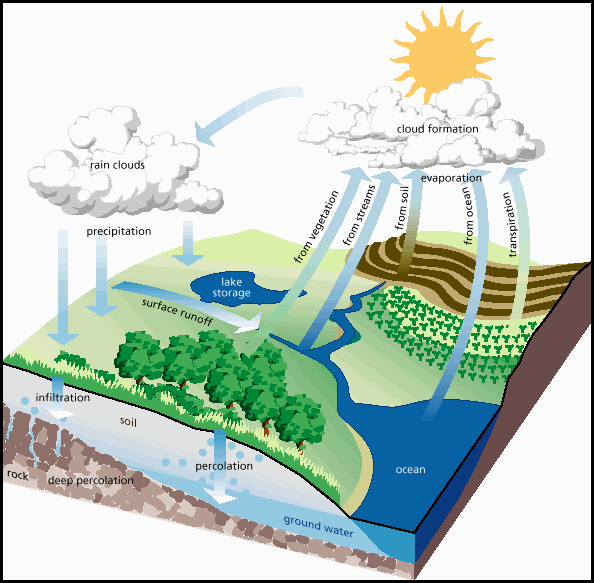
Thursday, we were at the Kerr Wildlife Management Area where we learned all about the water cycle and how vegetative cover on rangeland impacts everything from evapotranspiration to infiltration rates. We rained on plots, measured soil temps, infiltration, aggregate stability and watched various brush species waste water right before our very eyes. We swam in the spring fed Johnson Creek (awesomely beautiful) and worked on our notebooks which were due that evening. We finished off the day with snacks and a quiz bowl competition that ran past midnight!

Friday morning we did ranch plans, compiling all the knowledge we gained throughout the week. We presented our plans and gathered our things to return home. Closing ceremonies Friday afternoon included recognition for the cleanest cabin, leaders in our cabin groups, champion recreational group, best plant collections and notebooks, the Sam Coleman Award for combined notebook and plant collection achievement and the coveted Trail Boss award.

Woven throughout the week was the concept of stewardship. Directors presented the origins of the word stewardship and the biblical reasons we are called to learn to care for the land and the animals.

Plans are already underway for the 2012 Youth Range Workshop!

Have you attended or helped organize a range camp? What was your experience like?

Wednesday, July 6, 2011

High Desert Youth Range Camp Celebrates 1st Successful Year!

By Brenda Smith, Pacific Northwest Section


Group Photo

An extraordinary tradition that has been dormant for many years was renewed when 16 high-school age students from across Oregon and Idaho gathered June 19th-23rd for the first annual High Desert Youth Range Camp at the Northern Great Basin Experimental Range (NGBER) 40 miles west of Burns, OR. Well over a year ago a range camp committee made up of ARS scientists, Oregon State Cooperative Extension specialists, Treasure Valley Community College instructors and Harney County school district science teachers organized to develop the curriculum and logistics to host the camp at the 16,000 acre rangeland owned by the USDA-ARS. All told volunteers from nine agencies and local ranches committed their expertise and time as camp counselors, instructors, cooks to direct activities for the 4 day camp. The camp staff and presenters were all absolutely outstanding and put a tremendous amount of work and sacrifice to make range camp in Oregon a reality. The Pacific Northwest Section of SRM board of directors was instrumental in supporting the camp and provided a substantial financial donation to see range camp get off to a good start. A number of conservation districts and even private ranchers supported scholarships for students to attend.

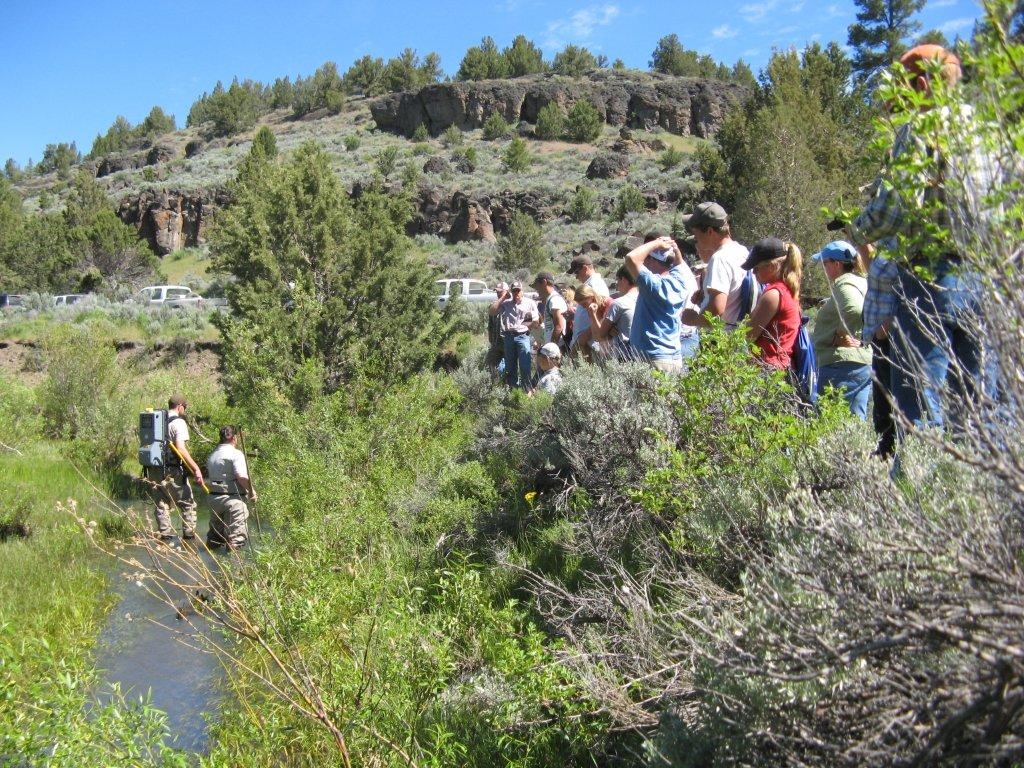
Riparian Studies
Top of the World (or a Butte)

Activities included map reading, GPS, compass and orienteering, soils investigation activities, plant identification and monitoring, interactions of fire, grazing and weeds, Juniper woodland investigations, wildlife presentations on mule deer and sage grouse, a visit to the nearby Hotchkiss Co. Ranch, riparian zone investigations, student team presentations, daily team building and leadership activities, and more. The students in attendance were interested, engaged, and adventurous and worked extremely well together. It was a downright “fun” learning experience. The top student selected to attend the SRM High School youth forum is Isaac Studtmann from Long Creek, OR. Just a few of the comments received from the students include “I feel that I have taken so much out of this camp and could see myself working in this field”, “I feel so much more informed about issues with rangeland management. I am now considering a career in rangeland management much more now!” and “Overall I think camp went very well and I am happy I came. Thanks for doing this for us.”

Soil tests
We all are very excited to have a range camp back in Oregon and look forward to keeping the renewed tradition going and growing.

Wednesday, June 29, 2011

Ethnobotany: An interesting perspective on range management, at a bombing range.

By: J. Johansen, SRM Student Member

Ethnobotany: the study of how a culture uses plants. But, who cares about plants anyway? Let alone knows their names, their relationships to each other and other living things? Aren’t all those cultures dead? I find it interesting that the American sub-culture of the range manager may be one of the few who still speak the language of plants.

Range Manager, or Plant Magician?
 On this year’s Pacific Northwest Summer Tour we got a real treat, a trip through the Yakima Training Center, the US Army’s live-fire training grounds. Our gracious host shared with us his job of keeping the soil on the ground, in spite of tanks, artillery, and fires. He guided us through test plots of grasses and shrubs planted in the late 90’s, describing how each had faired over time, and how well they stood up to the abuse of army vehicles driving over them. The test plots were really interesting, in that it could be seen what plants had failed completely, what plants wandered out of their row, what plants grew larger at the edge of their plot to try and outcompete it’s neighbor, and just the chance to work on identification. The YTC’s Botanist consultant set me strait that the “two” grasses I had were in fact the same, one just had a fungal infection (don’t worry, cheatgrass!). Also, in another area towards the end of our YTC tour, we looked at a test plot from 1961.


SRMer's speak the language of plants
Land destroyed by wildfire!

In this area we looked at the after effects of a wildfire and sage seedlings that had been planted last fall. The grasses and massive amounts of lupines in this photo and all throughout the burn area had come back on there own, without seeding. The sage seedlings were planted because a large portion of the burn was within a Sage Grouse protection area (yes, on a bombing range) and they wanted the sagebrush to return.

Intact sagebrush system with previously burned hill behind

We also visited sites outside the YTC grazed by the Martinez family’s bands of sheep. One of the Principals of the largest sheep operation in the state of Washington, Mark Martinez was generous to take time out of his day, show us several sites and discus the ins and outs of running seven bands of about 7,500 sheep total.

*** J. Johansen will be attending OSU’s Range program at Eastern Oregon University for his junior year this fall, is working as a NRCS student intern, and has no credibility whatsoever. You can take a peek at what he does in his spare time at http://www.rideherd.com.

Friday, May 27, 2011

Shining Horizons: Ranching for Resilience on Rocky Mountain Rangelands

A photography exhibit at Off the Beaten Path, Steamboat Springs, Colorado
May 2011


Photo by Matt Barnes
As a rangeland conservationist and ranch manager in western Colorado, I have the opportunity to live and work in a land of great beauty.  Indeed, the western landscape is what drew me to the rangeland profession in the first place.  Over the years, I’ve tried to capture a little bit of that beauty with my digital camera.  In the last year or so I’ve been doing a lot of ranch work, and since the ranching world tends to require long hours, I’ve often found myself working in photogenic places during the low-angle amber light of dawn and dusk, and many times I’ve realized that I was standing in a photograph, I just had to pull out my pocket digital, compose the shot, press the shutter button, and a great image was transferred from reality to pixels.

My photography has progressed from a pursuit of perfect, pristine landscapes to a documentation of living and working on the land.  What really excites me, as a land steward, as a writer and artist, and as a citizen, is harmony of humans with the rest of nature—not standing apart, either as directors or as leading actors in front of a static backdrop, but as an integral part of the greater whole:  a complex, self-organizing, adaptive system.
Photo by Matt Barnes
The American West is primarily a rangeland landscape, along with forested mountains and, in those few places that can be irrigated, grass meadows or small tracts of farmland.  But most of it is still rangeland, because it doesn’t make sense as farmland, ecologically or economically.  So, living on the land in most of the West means hunting and gathering, or the natural extensions of those life-ways: herding and gardening.  These activities, in and of themselves, are neither beneficial nor detrimental; their impact on the greater whole depends on how they are managed.  While in some places we are living with the legacy of poorly managed livestock grazing, there are many examples of livestock grazing where the health of the land is stable or improving. 

These examples of land stewardship for resilience are the heart of the next West, the agrarian West, and a few of them are featured in an exhibit of my best photographs, on display this month at Off the Beaten Path in Steamboat Springs, Colorado.
Photo by Matt Barnes
The exhibit is subtitled “ranching for resilience” because the best stewards recognize that they are part of a greater whole, and they manage for its resilience: the capacity of the system to withstand disturbance and retain or resume its essential structure and function.  Resilience goes beyond equilibrium concepts of sustainable yield of any product or even optimization of competing land uses, to embrace a non-equilibrium world.  In the long run, nothing can be sustained in perpetuity because the system is always evolving; the ultimate unforeseen consequence of our success is that we create a new reality to which we must then adapt, or be replaced.  To surpass sustainability, the goal of land management should be to maintain or enhance the resilience of systems in desirable states, and to find and capitalize on opportunities to improve the functioning of systems in undesirable states. In so doing, stewards strive to create harmony in landscapes of great beauty.
My photographs are an attempt to capture a little bit of this dynamic world of rangeland stewardship.  This exhibit is an opportunity to share a glimpse of this land of beauty with others, especially those who do not have the opportunity to live it every day.  If you are in Steamboat Springs this month, I hope you will stop by Off the Beaten Path and have a look.
Photo by Matt Barnes
Editor’s note:  Matt Barnes, CPRM, is Director (2010-2011) of the Colorado Section SRM, and serves the SRM on the Rangelands Editorial Board and the Applied Science Task Force.  He is owner of Shining Horizons Land Management, and manages the Howell Ranch near Cimarron, Colorado, from May-October.  You can follow his blog and see more of his photographs at www.ShiningHorizons.com.
 

Friday, May 6, 2011

International Rangeland Congress and Tours, Argentina

Guest Post by Joe Wagner, PNW Section of SRM


South Patagonia PreCongress Tour

El Calafate Moreno Glacier

The Pre-Congress Technical Tour started in El Calafate (State of Santa Cruz), where we spent two days.  El Calafate is located on the largest lake in Argentina.  This is a glacial lake and the Moreno Glacier is at the head of the lake.  The Moreno Glacier face is 300 feet high and it was calving at the late summer date we visited.  This glacier is part of the third largest ice field in the world – only behind Antartica & Greenland.

The 1st thing I noticed riding in from the airport was a roadside fence line contrast.  There was a lot of what I thought was a grey shrub and very little in the surrounding pastures.  This area was heavily sheeped in the past.  Checked with the tour guide and found out what I thought was a shrub was a large bushy Senecio.  The two main grasses were Fescue and Stipa.

Third Day we traveled by bus to Rio Gallegos to catch a flight to Tierra del Fuego area.  We visited an area at the east end of Lake Argentino, where grazing/wood cutting exposed the silty/sandy glacial soils to wind erosion.  They planted Elymus and shrubs to hold the soils in place.  It is still grazed to some extent.  We also observed heavy grazing and light grazing on a riparian/wetland areas (mallines = meadows where water is near the surface).  We visited a sheep Experimental area, where they were testing different grazing systems.  I learned about ground shrubs that the sheep use.  I casually looked at the plant they were talking about and initially thought it was a healthy cryptogam, however it did have a woody stem to it.  Inside the exclosure it was about 5/6 inches high after 5 years of rest.

Ushuaia Tierra del Fuego

We landed in Ushuaia that calls itself “City at the end of the world”, approximately 69 degrees south.  Of the Equator.  City is located on the Beagle Channel, where Charles Darwin spent time.  Historically, the Native Americans did not wear clothes; only seal skin capes (brrr!!).  The women were responsible for collecting mollusks.  They smeared seal fat on their bodies to insulate against the frigid waters.  The biggest resource problem I saw in Tierra del Fuego Park involved beaver.  They were introduced in 1943 to enhance the fur trade.  The fur trade fizzled and now they are running wild with no natural predators.  They are doing a job on standing trees as well as flooding out trees in the bottom lands.  Great Sea food in Ushuaia.

Rosario International Rangeland Congress

Rosario is a city of under one million people, in the State of Santa Fe.  It is a very clean city.  There are several stray dogs per block that laze about and help keep the food items out of the gutters.  The dogs don’t belong to anybody, but are fed, watered and tolerated by folks.  The only time I saw folks harass the dogs was when shop keepers shooed them out of the entrance to stores, when they flopped down.  It was amazing to see so many nice condition Ford Falcons from the 1960s driving around.  The Parana River flows through Rosario and fish dinners were great.

The IRC had about 500 people in attendance from 40 to 50 countries.  There were close to 700 papers/posters, 3 pre-congress tours and 3 mid-congress tours.  Proceedings will soon be available on the IRC website at http://www.rangelandcongress.com/ and available at catrina.batello@fao.org at no cost.  The next Congress will be in India in 2015.  I went on the Parana River Island mid-congress tour.  The river was in a low flood stage and most of the cattle had already been ferried across the river to areas west of Rosario.  However, it was interesting to see cows and calves swimming and some cows swimming and grazing at the same time.  I asked about caimans bothering the cattle (local ones are smaller than those in Amazon Basin) – wild pigs are more of a threat to calves.  The ranchers burn their lands by themselves every Fall, so they can find the cattle as the vegetation gets pretty thick and high otherwise.  The Poster I found the most interesting was from Israel, using goats to create fire breaks around forested areas.  I asked about the bad fire in their forest last summer and he said the crown fire dropped to the ground when it hit the goat grazed area. 


Iguazu Waterfalls Bariloche.

I made two trips after the congress.  Iguazu Waterfalls (state of Misiones) are way up north on the Brazil Argentina border.  One of the falls is horse shoe shaped at the head of a large canyon called the “Devils Throat.”  There are several falls on the Brazilian side and a long series of falls on the Argentina side.  This waterfall was as spectacular as Niagra Falls and Victoria Falls and the geology of the long canyon and rim made this a huge area.

The next trip was to Bariloche (State of Rio Negro) about midway in the country, but on the west side near the Andes mountain range.  The area was settled by Swiss and German pioneers. The architecture with the Andes backdrop made one feel that they might have been in the Alps.  Cathederal Hill is probably the only major ski area in South America.  The rainfall in Bariloche was 1,000 millimeters near the mountains and going 35 km east and it drops to 500 mm and continues drop to about 250 mm as you go east until the Atlantic Ocean influence raises the rainfall.  I was able to visit the San Ramon Estancia (Ranch) in the 500 mm zone and there were many conifers growing, all introduced from Europe, Australia and North America.  The Ranch produced cattle that grazed the meadows and sheep that grazed the upland steppe.  The ranch was 250,000 hectares in size.  The entire ranch and buildings were burned in a wildfire in 1996 and the manager said vegetation was still recovering in certain areas.  I thought I was standing in grass in a rest pasture, but was I wrong.  It was a Stipa that came half way up my calf and neither cattle nor sheep will graze it.  The trees that they were selectively logging had ½ to ¾ inch growth rings present from about 40 year old trees.  The introduced Red Deer grow some tremendous racks 2 ½ to3 feet wide with 16 points on some.
Beautiful, unpalatable stipa
 Argentina has the highest per capita meat consumption in the world – 75 kg/person.  We ate well and a high protein diet it was great!!

Tuesday, April 5, 2011

Our Juniper Story is Told

Click here to watch this excellent video about western juniper and featuring SRM members Doc and Connie Hatfield, Dr. John Buckhouse, Tim Deboodt, Michael Fisher and Hugh Barrett
 

Guest Post by Hugh Barrett, SRM Pacific Northwest Section 

Following a friend’s communication with Oregon Public Broadcasting inquiring about their interest in doing a program on western juniper in Oregon, I received a call from Vince Patton, Producer of Oregon Field Guide – OPB’s popular weekly outdoor program. He told me that during his trips to eastern Oregon he’d always wondered why “ranchers were cutting all that juniper”. As we talked, Vince seemed increasingly interested in producing a segment for the program.  Subsequently, I sent an email to Vince that contained links to several publications on western juniper and the names and contact information for several scientists, ranchers and others who also are deeply involved in the juniper issue.

During several phone conversations I had with Vince over the next few months, I laid out the story of juniper in the inter-mountain environment. His interest grew as I described the steps and mis-steps leading to the rapid expansion of juniper’s range; its impacts on the sagebrush biome; and, its influence on watershed function and western aridity. On a windy mixed rain-and-snow afternoon about three months after our original phone conversation, we met in Doc and Connie Hatfield’s living room at their High Desert Ranch near Brothers, Oregon. Fortifying ourselves against the cold with bowls of hot chili and warm corn bread, we planned the process for the next two days filming.

That’s how it all came together. I hope the program speaks for itself.

 Click here to watch the video

50 acre juniper control/watershed repair project in Klamath County, Oregon (before treatment)

Project area in 2007 after treatment conducted in 2006.  Broadcast seeding with "Whitmar" bluebunch wheatgrass, antelope bitterbrush, basin wildrye (in swales and drainages) and big sagebrush.  Cut trees were skidded off the hillside (for use as firewood and lumber).  Anticipated hydrologic response: 15 acre feet per year of water retained.

Thursday, March 24, 2011

Range Camp Rocks

Spring is finally upon us.  For students, the melting of winter signifies that it is time to start thinking about summer break and how you will spend your time.  What could you possibly do to maximize both fun and professional development simultaneously?  For those high school students interested in rangelands, the answer is easy: attend range camp.  Visit your local SRM section website and contact the officers to find out what opportunities are in your area.  Below is an article by Terilyn Chen outlining exactly why Range Camp Rocks.

Range Camp Rocks
September 11, 2010 Posted in: Opinion
By: Terilyn Chen


This summer I vaccinated a sheep. With help, of course.

I learned to do that, among other things, at the 26th annual California-Pacific Range and Natural Resources Camp. I attended camp from June 20 to June 25 with Hercules High School senior Nicole Ng, and other students from all over California. Founded by Mike Stroud in 1985, Cal-Pac Range Camp is an annual environmental science camp held on the beautiful Elkus Ranch in Half Moon Bay.

Ng and I were among the few campers who had absolutely no experience working with livestock and ranches. Herculean culture is entirely different; I doubt many people know what FFA is and we do not have a farm. I am embarrassed to admit, but before camp, I thought everything related to hardcore agriculture and livestock was for Texans and Montanans. Somewhere in my head, I obviously knew California is a big farming state, but I just never thought there would be a camp that taught about livestock so close to home. Needless to say, the experience was an eye-opener.

At camp, we were constantly busy. Never in my life had I felt so accomplished when the day was over as I did during those four days. Every single minute was well spent, whether I was learning how to tell the difference between yarrow and poison hemlock, searching for fly larvae underneath the rocks in Purisima creek or talking about boys with a couple of buddies while walking across camp to take a shower. We even spent half a day in bright yellow hard hats, walking around Purisima Creek Redwood Forest with a forester who showed us how he decides what trees to cut, and why.

By the end of the first day, I was falling in love with range camp and everything I never knew California possessed.

The world that had previously seemed to me full of ubiquitous settling and compromising had something tangible to offer me: real examples of people simply unable to contain their passion.

The camp coordinator Marc Horney, the botanists, soil scientists, fire ecologists, entomology connoisseurs- every single one of our instructors and advisors were obviously in love with what they did. Their bubbling excitement was intoxicating, as was the magical environment they had chosen to use as their classrooms, because really, velvet grass makes such an impression.

I felt so complete when the sun was disappearing behind the hills. Several times, I wanted to cry because camp made it seem like there was a reason for everything. Since then, I have believed in the goodness of people again. Or rather, I believe in my own strength; it was as if camp made me realize that I can make a difference. Suddenly, beating global warming and climate change seemed possible.  After all, there were people out there running camps about environmental science.

The night before our last day at camp, I knew that I would soon mentally go over every memory and physically touch every plant I could get my hands on, in a crude attempt to hold on to Range Camp.  The next day, when I actually left Elkus Ranch, and my family drove away with me on the freeway, I felt traumatized, as if my senses were not yet adjusted to the loudness, the hardness and the greyness of the world. For the next few days, I felt lost in suburbia. I was lost in the uniformity and the cleanliness.  Over the course of the summer, I would dream about Range Camp for a total of seven times.

Later, walking around Hercules, I actually found flowers and grasses that I could identify. I realized that there is no reason to be sad because I had taken so much from Range Camp. So thank you, Kent Reeves and the Yolo County Resource Conservation District for sponsoring me, and thank you both Michael Hudson and Nicole Ng for introducing me to Range Camp.

Range Camp has enlightened me. It has changed me. It has permanently made me a “happy camper.”