Showing posts with label Events. Show all posts

Tuesday, August 2, 2011

2011 Summer Board Meeting

By Maggie Haseman, Outreach Intern

It’s mid-summer and we all know what that means: the summer Board meeting! I know you were probably thinking ice cream, but don’t worry there was a little of that too. The Board of Directors traveled to the Society for Range Management headquarters office in Wheat Ridge, Colorado to work through critical SRM operating items. They worked on the budget, discussed updates on projects and committee work and held a special Action Update Call. They also focused on membership member renewals, the website and SRM outreach material and upcoming Annual Meetings. The Board is heading home after two solid days of discussion.

During the Action Update Call

Now, we know that you know that we know that you know who is on the BOD but do you really know the BOD? Let’s find out. Here are a few snippets to get to know these individuals:

Dr. Stephanie Larson-Praplan, Director 2010-2012, California-Pacific Section

Stephanie was born in Vancouver, WA. She was raised on a sheep farm in Idaho, which is where her interest in rangelands began. Her mentors Jim Clausen and John Buckhouse guided her to join SRM. According to Stephanie, her colleagues are her favorite part of SRM membership. Get this, in her free time, Stephanie runs half-marathons! Her favorite books are those in The Lord of the Rings series by J.R.R. Tolkein and interestingly her favorite ice cream flavor is licorice.

Keith Klement, Director 2010-2012, Wyoming Section
Keith was born in Muenster, TX. He was a student at Texas Tech on the Plant ID team when he decided to join SRM. In his opinion, the best thing about SRM is the chance to interact with diverse individuals who share an interest in rangelands. I bet you didn’t know that he grew up on a dairy farm. Keith’s favorite book is The Bible and he loves vanilla ice cream.


Jack Alexander, President, International Mountain Section
Jack was born in Nashville, TN. He joined SRM so that he could compete in the Undergraduate Rangeland Management Exam at the Annual Meeting. His favorite thing about SRM is the passion he sees that range professionals have for rangelands. Something you might not have known about Jack is that he has a collection of old motorcycles. His favorite book is 1,491 by Charles Mann and his favorite ice cream flavor is mocha almond fudge.


Dr. Val Jo Anderson, Director 2011-2013, Utah Section
Val was born in Ephraim, UT. He was a student when he joined SRM and continued to be involved in the plant ID team, undergraduate papers and the national conclave. He enjoys being a member of SRM because it serves as an outlet for management literature and he has the chance to network, meet and have discussions with experts who manage rangelands in similar ways. Something interesting about Val that you might not have known is that he has done range research on every continent except Antarctica. His favorite book is Roughing It by Mark Twain and his favorite flavor of ice cream is butter pecan.
Wally Butler, Second Vice President, Idaho Section
Wally was born in Brigham City, UT. He got a bachelors degree in animal science and during the peak of the Vietnam War decided to continue his education and get a masters degree in range management. His major professor joined SRM in its second year (1950!) and encouraged all his students to join. Since joining, the things Wally has enjoyed most about SRM are the networking opportunities and the people he has met. Something you probably didn’t know about Wally is that he raises stock dogs and ships them all over the world. His favorite book is Undaunted Courage by Stephen Ambrose and his favorite ice cream flavor is strawberry.
Dr. Charles Hart, Director 2009-2011, Texas Section
Charlie was born in Lubbock, TX. He joined SRM as a student and has been a member ever since. His favorite thing about being a member of SRM is the camaraderie he finds in the people and the friends he has made. You might be surprised to learn that Charlie lived in New York for six years. His favorite book is Lonesome Dove by Larry McMurtry and he enjoys mint chocolate chip ice cream.


Misty Hays, Director 2011-2013, Wyoming Section
Misty was born in Mission, South Dakota. When she was in college she attended her first Annual Meeting, which led her to join SRM. She loves the fact that through SRM she has a place to talk to her peers who share a common ground. Something you will find interesting about Misty is the fact that she has been involved in range management since she was five years old. She will read anything by Mary Higgins Clark and her favorite flavor of ice cream is chocolate.


Gary Frasier, First Vice President, Colorado Section
Gary was born in Imperial, NE. When he was working in Phoenix, AZ a past president came in to talk to him, as he was leaving he handed Gary an SRM member application and told him to fill it out by the next day; that’s when Gary joined SRM. His favorite thing about SRM is the people. You will probably be shocked to find out the Gary has never received an education in range management. He loves to read all science fiction books and his favorite flavor of ice cream is butter pecan.


Jess Peterson, Executive Vice President
Jess was born in Powell, WY. He joined SRM in order to have access to the scientific applications and get more information about rangeland management. What he enjoys most about SRM are the annual and section meetings and the enthusiasm they generate. You probably didn’t know that he runs cattle on two counties in Montana. His favorite book is John F. Kennedy on Leadership: The Lessons and Legacy of a President by John Barnes, and he loves chocolate chip cookie dough ice cream.


Sandra Wyman, Director 2009-2011, Pacific Northwest Section
Sandy was born in Westby, WI. In college she was studying range management and was in the range club, which was affiliated with SRM, so she joined. Her favorite thing about being an SRM member is the networking opportunities and the exchange of science. You might be surprised to find out the Sandy grew up on a farm where they raised horses and tobacco. Her favorite books are the Harry Potter series by J.K. Rowling and she enjoys eating chocolate flavored ice cream.

Have questions for the SRM Board of Directors? Comment here, email them individually, and get on the Action Update Call each month to ask them directly. They work for you.

Friday, June 3, 2011

SRM Welcomes Maggie Haseman, SRM Summer Outreach Intern

Maggie Haseman, tired after a long hike to our campsite on a father-daughter backpacking trip to Crater Lake in July 2010
Hi SRM, my name is Maggie Haseman and I am the new Outreach Intern here at the SRM office in Wheatridge, Colorado.  I will be a senior at Colorado State University in the fall.  I am working toward a Bachelor of Science Degree in rangeland ecology with a concentration in restoration ecology and a minor in global environmental sustainability.  After I graduate, I want to get a Master’s Degree in ethnobotany, the study of the relationship between plants and humans.  Eventually I would also like to go to law school and study environmental law.

I have lived in colorful Colorado all my life and am currently living in Fort Collins, CO.  I enjoy many activities such as hiking in the beautiful Rocky Mountains and playing the ukulele.  I also play tennis, when I get the chance, and spend time playing cards or board games, and chatting with my friends and family.

I am a first-year SRM member and heartily enjoyed attending the SRM Annual Meeting in Billings last February, where I competed in the plant ID competition.  I am very happy to have the chance to get more involved in the society through this summer Internship Program.  You will hear from me often on the SRM Outreach Blog, Facebook page and LinkedIn group until August when I must go back to school.

As the Outreach Intern I have been working on various projects for SRM including helping with the details for the 2012 Annual Meeting in Spokane, Washington, and organizing a meeting contact list so that the Society can be more efficient and organized about contacting parites for news and events related to the Annual Meeting.  I plan on using my experience at SRM and my interests in both rangelands and ethnobotany to write a series of blog posts on the history of the American Great Plains.  I would like to look into the ways that humans have shaped the ranges and also how the ranges have shaped us.

Tuesday, May 24, 2011

Save the Date: Ecological Site Description Training Workshops

ESD - Save The Date
Ecological Site Description (ESD) Training Workshops

Society for Range Management (SRM) has been moving forward with the planning of additional ESD training workshops following the successful Pilot Interagency Range ESD Workshop in November 2010. We are excited to announce that three regional based efforts are currently under development.

The following information is intended to briefly update interested parties on these upcoming workshops. More information on agendas and accommodations will be forthcoming in the near future. Website information updated regularly. Registration will be on a first-come first-served basis and should be live no later than end-of-June 2011.

Please note that the workshop under planning for Reno, NV - August 2-4, 2011 - is now RESCHEDULED for June 2012.

Details for a second workshop scheduled for August 23-25, 2011 in Cheyenne WY are provided below.

Also note that a third workshop is under planning for Florida in early November 2011. 


INTERAGENCY ECOLOGICAL SITE APPLICATIONS WORKSHOP
Cheyenne WY/Nunn CO
23-25 August 2011

For registration and lodging questions, please contact:
Aleta Rudeen
SRM Director of Outreach and Leadership Development
arudeen@ranglands.org
(303) 720-2715

For all other questions, please contact:
Linda Coates-Markle
BLM Liaison to SRM
lcmarkle@rangelands.org
(303) 986-3309

Friday, May 6, 2011

International Rangeland Congress and Tours, Argentina

Guest Post by Joe Wagner, PNW Section of SRM


South Patagonia PreCongress Tour

El Calafate Moreno Glacier

The Pre-Congress Technical Tour started in El Calafate (State of Santa Cruz), where we spent two days.  El Calafate is located on the largest lake in Argentina.  This is a glacial lake and the Moreno Glacier is at the head of the lake.  The Moreno Glacier face is 300 feet high and it was calving at the late summer date we visited.  This glacier is part of the third largest ice field in the world – only behind Antartica & Greenland.

The 1st thing I noticed riding in from the airport was a roadside fence line contrast.  There was a lot of what I thought was a grey shrub and very little in the surrounding pastures.  This area was heavily sheeped in the past.  Checked with the tour guide and found out what I thought was a shrub was a large bushy Senecio.  The two main grasses were Fescue and Stipa.

Third Day we traveled by bus to Rio Gallegos to catch a flight to Tierra del Fuego area.  We visited an area at the east end of Lake Argentino, where grazing/wood cutting exposed the silty/sandy glacial soils to wind erosion.  They planted Elymus and shrubs to hold the soils in place.  It is still grazed to some extent.  We also observed heavy grazing and light grazing on a riparian/wetland areas (mallines = meadows where water is near the surface).  We visited a sheep Experimental area, where they were testing different grazing systems.  I learned about ground shrubs that the sheep use.  I casually looked at the plant they were talking about and initially thought it was a healthy cryptogam, however it did have a woody stem to it.  Inside the exclosure it was about 5/6 inches high after 5 years of rest.

Ushuaia Tierra del Fuego

We landed in Ushuaia that calls itself “City at the end of the world”, approximately 69 degrees south.  Of the Equator.  City is located on the Beagle Channel, where Charles Darwin spent time.  Historically, the Native Americans did not wear clothes; only seal skin capes (brrr!!).  The women were responsible for collecting mollusks.  They smeared seal fat on their bodies to insulate against the frigid waters.  The biggest resource problem I saw in Tierra del Fuego Park involved beaver.  They were introduced in 1943 to enhance the fur trade.  The fur trade fizzled and now they are running wild with no natural predators.  They are doing a job on standing trees as well as flooding out trees in the bottom lands.  Great Sea food in Ushuaia.

Rosario International Rangeland Congress

Rosario is a city of under one million people, in the State of Santa Fe.  It is a very clean city.  There are several stray dogs per block that laze about and help keep the food items out of the gutters.  The dogs don’t belong to anybody, but are fed, watered and tolerated by folks.  The only time I saw folks harass the dogs was when shop keepers shooed them out of the entrance to stores, when they flopped down.  It was amazing to see so many nice condition Ford Falcons from the 1960s driving around.  The Parana River flows through Rosario and fish dinners were great.

The IRC had about 500 people in attendance from 40 to 50 countries.  There were close to 700 papers/posters, 3 pre-congress tours and 3 mid-congress tours.  Proceedings will soon be available on the IRC website at http://www.rangelandcongress.com/ and available at catrina.batello@fao.org at no cost.  The next Congress will be in India in 2015.  I went on the Parana River Island mid-congress tour.  The river was in a low flood stage and most of the cattle had already been ferried across the river to areas west of Rosario.  However, it was interesting to see cows and calves swimming and some cows swimming and grazing at the same time.  I asked about caimans bothering the cattle (local ones are smaller than those in Amazon Basin) – wild pigs are more of a threat to calves.  The ranchers burn their lands by themselves every Fall, so they can find the cattle as the vegetation gets pretty thick and high otherwise.  The Poster I found the most interesting was from Israel, using goats to create fire breaks around forested areas.  I asked about the bad fire in their forest last summer and he said the crown fire dropped to the ground when it hit the goat grazed area. 


Iguazu Waterfalls Bariloche.

I made two trips after the congress.  Iguazu Waterfalls (state of Misiones) are way up north on the Brazil Argentina border.  One of the falls is horse shoe shaped at the head of a large canyon called the “Devils Throat.”  There are several falls on the Brazilian side and a long series of falls on the Argentina side.  This waterfall was as spectacular as Niagra Falls and Victoria Falls and the geology of the long canyon and rim made this a huge area.

The next trip was to Bariloche (State of Rio Negro) about midway in the country, but on the west side near the Andes mountain range.  The area was settled by Swiss and German pioneers. The architecture with the Andes backdrop made one feel that they might have been in the Alps.  Cathederal Hill is probably the only major ski area in South America.  The rainfall in Bariloche was 1,000 millimeters near the mountains and going 35 km east and it drops to 500 mm and continues drop to about 250 mm as you go east until the Atlantic Ocean influence raises the rainfall.  I was able to visit the San Ramon Estancia (Ranch) in the 500 mm zone and there were many conifers growing, all introduced from Europe, Australia and North America.  The Ranch produced cattle that grazed the meadows and sheep that grazed the upland steppe.  The ranch was 250,000 hectares in size.  The entire ranch and buildings were burned in a wildfire in 1996 and the manager said vegetation was still recovering in certain areas.  I thought I was standing in grass in a rest pasture, but was I wrong.  It was a Stipa that came half way up my calf and neither cattle nor sheep will graze it.  The trees that they were selectively logging had ½ to ¾ inch growth rings present from about 40 year old trees.  The introduced Red Deer grow some tremendous racks 2 ½ to3 feet wide with 16 points on some.
Beautiful, unpalatable stipa
 Argentina has the highest per capita meat consumption in the world – 75 kg/person.  We ate well and a high protein diet it was great!!

Wednesday, April 13, 2011

Spring Cleaning: Reminders, Updates, and Events

Greetings SRMers!  Here are a few upcoming events and deadlines relevant to you:
  • Applications for the SRM paid summer Internship Program are due this Friday, April 15.  Additional information and application instructions can be found on the SRM employment page.
  • It's time to start thinking about the 2012 Annual Meeting in Spokane, Washington!
    • Applications for symposia, special sessions, forums, and workshops are due by Saturday, May 7.  Click here for application information and forms.
    • Meeting room requests for the 2012 meeting are due by Wednesday, June1.  You must have your request in to the Spokane planning committee for your event to be included in the Annual Meeting program.  Click here for the room request form.
  • SRM is now on LinkedIn!  This is a SRM members-only group - sign in or sign up and start getting connected to other SRM members.
  • Calling all sections: help us keep the www.rangelands.org website updated and encourage participation in your section events by sending us your summer tour and fall meeting information at your earliest convenience.  Send meeting information to Ann Tanaka and Vicky Trujillo.
  • The SRM Board of Directors Washington DC fly-in is scheduled for May 2 - 5, 2011.  Stay tuned for details from their trip.
  • Join us for the SRM Action Update Call, this Thursday, April 14 at 11:00am MDT.  This is your opportunity to ask questions and find out the latest in the Society.  This call is open to anyone that would like to join.  Dial: 1-213-416-6650, Access Code: 012010#
In other news, this Saturday, April 16, marks the first ever SRM Office Beautification Day!  We will be hosting the University of Wyoming and Colorado State University range clubs onsite for an office overhaul.  Activities include planting, mulching, and general sprucing of the SRM office, not to mention an excellent opportunity for networking between clubs.  Many thanks to both range clubs for their participation and stay tuned for details and highlights.

Katelyn Schade (UW Range Club) and Robert Emanual (CSU Range Club) met with Jess Peterson and Aleta Rudeen to plan the SRM Office Beautification Day Projects last week
We're not kidding - we have our work cut out for us this weekend!  More before and after photos to come...

Friday, January 28, 2011

New Member Coffee at the Billings Annual Meeting


 New Member Coffee

Monday, February 7, 2011
7:30am – 8:30am
Poolside Terrace, Holiday Inn Grand

YOU are invited to attend the New Member Coffee before the Plenary Session at the Billings Annual Meeting.  Coffee and pastries will be provided and the event is FREE of charge.  This is your opportunity to meet SRM leadership and find out about the structure of the Society, how to get involved, tips and tricks for networking, and how to maximize your membership.  We look forward to seeing you there!

Agenda

7:30   Welcome (Aleta Rudeen, Director of Outreach and Leadership Development and Jess Peterson, SRM Executive Vice President)

·         Coffee, introductions, sign-up sheet
·         Social media and SRM

7:40   Introduction to the Structure of SRM (Jeff Mosley, SRM President)
·         Board of Directors, section, committee and staff organization
·         Who does what and how to contact the right people for the right things

7:55   Navigating the Annual Meeting (Gary Frasier, SRM Second Vice President)
·         Organization of the meeting
·         Events to attend and how to maximize your time

8:05   Getting Involved and Getting the Most from your Membership (Jack Alexander, SRM First Vice President)

·         HOW to get involved in SRM, at the section or international level
·         WHO can get involved in which activities
·         Other ways to be an active member (committees, certifications, etc.)

8:20   Professional Development (Linda Coates-Markle, BLM-SRM Liaison)
·         How to use your membership to your advantage
·         Where to look for employment opportunities
·         How to maximize your networking at the meetings and beyond

8:30   Adjourn

Monday, January 24, 2011

Native Range Session at the 64th Annual Meeting in Billings, Montana

Guest post by Diana Doan-Crider


On February 10, 2011, the SRM will be hosting a special one-day Native Range Session during the 64th Annual Meeting in Billings, Montana, to discuss RANGE MANAGEMENT ON TRIBAL LANDS.

The United States Government holds 55.7 million acres of land in trust for Native Americans, of which much is considered to be rangeland.  Native vegetation on the rangelands provide habitat for native wildlife and livestock, and provide other resources needed for a high quality life for the Native Americans.  Dynamic and high quality management of rangelands is essential for the success of the Native American communities.  Successful management of the rangelands, which includes a wide variety of resources, must not be focused on a single objective but rather on achieving a wide variety of habitat objectives that best meet the social, cultural, economic, and physical needs of the tribe.

Rangeland management practices and needs vary on the numerous reservations, ranging from livestock that is owned by non-member individuals or corporations, or by individual tribal members and livestock cooperatives.  Range management programs also vary widely between tribes.  In some cases, the Department of the Interior - Bureau of Indian Affairs (USDI-BIA), develops range management plans.  Some reservations, however, manage their own rangelands through the tribe’s Natural Resources Department.  It other cases, tribes receive assistance through liaisons appointed by the US Department of Agriculture’s Natural Resources Conservation Service (USDA-NRCS).
The Society for Range Management’s mission is to promote the professional development and continuing education of members and the public and the stewardship of rangeland resources.  The Native American Range Initiative involves partnerships with tribes and the various federal agencies involved in range management in order to achieve this mission.  Recognizing the numerous changes that have and are occurring in the management and use of the Native American rangelands, the Society is sponsoring this workshop to discuss the various challenges and needs for range management on tribal lands, training opportunities, and education of future tribal range managers.  This session offers the opportunity to see how the Society’s programs and broad membership might partner to help serve the needs of Native American rangeland communities, including the managers and those who depend on the rangelands.

We are inviting both tribal members and conference participants who are directly involved with range management on tribal lands to participate in this workshop.  The SRM conference DAILY registration fee of $80 has been sponsored for up to 25 tribal members for this session; there is no additional charge for regular conference participants.  A brainstorming period will follow, so we ask that participants attend for the entire duration of the session.  Attendance is limited; lunch is not included.  The workshop will be hosted from 8:00 am – 5:00  pm at the Billings Hotel and Convention Center – specific location will be announced on site.  For more information or to sign up, please contact Diana Doan-Crider at http://www.blogger.com/d-crider@tamu.edu, or call (830) 431-2770.

Friday, January 21, 2011

Tapping The Top - the Professional-Student Interaction Function

Guest post from the Billings Annual Meeting Committee

You are invited to:
Tapping The Top
Profesional-Student Interaction Function
Monday, February 7, 5:00-7:00pm
Billings Annual Meeting 

Tapping the Top (TTT) enters its 24th year in Billings, Montana. All students who are interested in a career in range management are encouraged to attend the Tapping The Top Student – Professional Function. TTT offers students the opportunity to visit with experienced range professionals about what it is like to have a career in range management. Students talk to professionals about what it is they do day to day in their job, what they enjoy most, and what they would have done differently in a casual atmosphere. It is a great opportunity to find out about the broad scope of jobs and regions to work in the range profession. You will get the scoop on what you want to do from someone who has been doing it for a few decades.

Professionals, if you want to share what you have learned with the students who will be filling your shoes as future range professionals please attend Tapping The Top. We appreciate your 20 plus years of great support. We invite all professionals with experience and enthusiasm to attend TTT and share it with these young professionals. This is your change to have an impact on the profession of range management.

Monday, January 17, 2011

Welcome to the Billings Annual Meeting from the Billings Planning Committee

TRANSCENDING BORDERS - LANDSCAPES AND LEGENDS


_________________________________________________________
Just wanted to remind everyone the 64th SRM Annual Meeting is fast approaching. This year’s meeting will be held in Billings, Montana February 6-11, 2011. The meeting promises to be both worthwhile and informative with talks on a wide array of subjects including Native History, Contrasting Lewis and Clark’s Trip Through the Great Plains with Present Day, Historical Changes in Rangeland Management, Birds, Bugs, Popular Notions and the Range. Visit the meeting website (www.rangelands.org/billings2011) to start planning your top priority sessions and events.

While at the meeting, make sure to attend the Producer’s Forum: The Art of Grazing Management on Tuesday, February 8th, as well as one of over 20 symposia focusing on such topics as Sustainable Ranch Management, The Ecology of Seedling Establishment, Expiring CRP: Alternative Management Systems, Rangeland Pollinators: Emerging Issues, and many more. A complete list of symposia can be found by clicking here.

In addition to the many great talks there will be technical tours to the Pryor Mountain Horse Range, Pompey’s Pillar and the Little Bighorn Battlefield.

The Billings Annual Meeting will provide numerous opportunities for attendees to “Transcend Borders” by developing and strengthening working relationships with other SRM members and individuals and organizations that share a passion for the world’s rangelands.

If all that isn’t enough to get you excited for the meeting, then come “Catch the Beaver Fever” and cut a rug to Bucky Beaver and the Ground Grippers at the dance on Tuesday night, February 8th. Still not enough… come dine on some fine Montana home grown cuisine during the Wednesday night Eventing in Montana non-banquet, while being entertained (and trust me you will be entertained) by Montana’s own Ringling 5!  For a complete list of special events, click here.

While it may be cold outside, we promise you’ll be too entertained and informed inside to notice…


Friday, January 14, 2011

Upcoming Symposium: Breaking the Current Fire Cycle, February 1-2, 2011

Guest post by Neil Rimbey, Idaho Section

Burning Rangeland
The Boise District BLM Resource Advisory Council, the Society for Range Management, the Agricultural Research Service, Natural Resources Conservation Service and others are sponsoring a Symposium on February 1-2, 2011 in Boise, Idaho. “How Can Resource Management Break the Current Fire Cycle?” is designed to identify fire, fuel and vegetation management methods appropriate for conserving high value and degraded Wyoming Sagebrush steppe habitats by reducing fire frequency. The session will be highlighted by the Keynote Address by Dr. Jim Young, author of the recent book, Cheatgrass: Fire and Forage on the Range. Jim will summarize over 40 years of research on the ecology, management and control of cheatgrass. This background information will set the stage for jumping into 5 key questions:
  1. Given the opportunity to develop major, strategic fire breaks, what kinds of fuel breaks would be effective and affordable to create, maintain and persist?
  2. What other kinds of fuel breaks and tools can be used most effectively in areas with frequent wildfires and areas which still maintain Wyoming sagebrush stands?
  3. In light of listings of threatened or endangered species in the sagebrush steppe system, is a fuel reduction program feasible and what suitability criteria, mitigation and administrative procedures will allow for its establishment?
  4. How can various fuel reduction tools be coordinated across land ownerships to facilitate the next step of rangeland rehabilitation?
  5. What monitoring and management protocols can be established to ensure that we achieve short-, intermediate- and long-term goals associated with fuel management, decreasing fire frequency and rangeland rehabilitation?
These questions will be explored by panels of experts and practitioners associated with each area. They will involve active audience participation through questions and dialog.

The session will be held at the Washington Group International Conference facility (800 Park Blvd.) in the heart of downtown Boise. More information is available via the following website:
http://www.blm.gov/id/st/en/res/resource_advisory/boise/boise_district_rac.html

Additional questions? Contact Neil Rimbey (208-454-6566 or nrimbey@uidaho.edu), or Ted Hoffman (208-587-6374 or brokeno@mindspring.com )

Fire

Monday, January 3, 2011

Happy New Year from SRM

Happy New Year from the Society for Range Management! Wondering how to get involved in 2011? Here are some helpful hints from the Society:
  • Join a committee. Working on an SRM Committee is one of the best ways to get involved in the Society and an excellent way to get in touch with the people who share your interests. Visit the committee webpage for a committee list, including points of contact for each.
  • Attend the 64th Annual Meeting in Billings, MT, February 5-11, 2011: Transcending Borders: Landscapes and Legends. Register now – online registration closes January 23.
    • The New Member Coffee will be held Monday, February 7 at 7:30am. This is a FREE event for all new (and returning) members to learn about the structure and organization of SRM, hear tips for navigating the Annual Meeting, and learn about how to get involved in the Society. Coffee and pastries will be provided and all new members will receive a FREE one year online subscription to Rangelands.
    • The JOB Fair, held Sunday, February 6 from 10:00am – 6:00pm will be the place to be for those exploring career options or thinking about the next step. JOB Fair booths are FREE and employers should submit a registration form no later than January 14, 2011.
    • Check out An Evening in Montana while at the meeting for local food, flare, and entertainment. The event will take place Wednesday, February 9, at 7:00pm.
    • Attend networking events, such as Tapping the Top Mixer, and Agency and University Socials.
    • Visit the Trade Show to see the latest and greatest in rangelands today.
    • And much more! Check out the Annual Meeting Pre-Convention Trailboss to start planning your week in Billings.
  • Renew your membership using the new cafeteria-style dues structure. Base rates are now $70 regular, $25 student and international, with additional charges for online and printed subscriptions to journals. For a full explanation of the new dues structure, click here.
    • Did you know SRM has an apprentice membership category? A special $50 apprenticeship rate is available for the first five years after graduation to former student members. All you have to do is renew your membership before it lapses, and you are eligible for the reduced apprentice membership rate.
  • Attend the International Rangeland Congress meeting in Rosario, Argentina, held April 2 – 8, 2011.  Diverse Rangelands for a Sustainable Society.
  • Become a fan of SRM on Facebook and receive pertinent updates right to your newsfeed.
  • Attend your local Section meetings and tours. SRM Sections are the best place to start networking and take your membership to a new level. Section events (as well as other events of interest) are updated regularly on the SRM webpage as well as on the Section websites.
  • Get on the Action Update Call each month to hear from SRM leadership and staff and make your voice heard. The Action Update Call takes place the second Thursday of every month at 11:00am MST. Dial-in number: 1-213-416-6650, Access Code: 012010#.
  • Get certified! SRM offers two certification programs: Certified Professional in Range Management and Certified Range Management Consultant Program.
Have a productive, fun, and engaging 2011, and we will see you in Billings this February!

Tuesday, December 14, 2010

2011 Rangeland JobFair

Guest Post by Linda Coates-Markle, SRM-BLM Liaison


We are looking for employers to have a
BOOTH at the 2011 Rangeland JobFair!


Folks,

Aspiring new range professionals need your help. We are looking for employers to have a BOOTH at the 2011 Rangeland JobFair.

Even if you currently have no available positions, consider being there to talk to enthusiastic candidates who are wanting to know what the rangeland profession has to offer them. Our workforce numbers are dwindling and we all need to do a better job of recruitment. A little bit of your time can go along way to inspiring exceptional candidates to join the future workforce.

The JobFair is being offered Sunday Feb 6, 2011 at the Billings Hotel and Convention Center in conjunction with the 64th SRM Annual Meeting and Trade Show.

ITS FREE...........all you need to do is fill out a reservation form and return it to the SRM headquarters office.  For more details and the reservation form click here.

Reservation forms must be received by Friday January 14th, 2011. If you have any questions, please give me a call or send me an email. I look forward to hearing from you.

Sincerely,

Linda Coates-Markle
JOBFAIR Coordinator, BLM-SRM Liaison
10030 W. 27th Ave.
Wheat Ridge, CO 80215-6601
Phone: 303-986-3309
Fax: 303-986-3892
Email: lcmarkle@rangelands.org

Monday, November 29, 2010

Interagency Rangeland ESD Pilot Workshop

 
The Interagency Rangeland Ecological Site Description (ESD) Pilot Workshop was held November 16 - 18, 2010 in Las Cruces, New Mexico.  The workshop was a huge success with over 85 participants and three full days of excellent presentations and valuable discussions.  The Pilot Workshop convened technical leadership from the Natural Resources Conservation Service, Bureau of Land Management, and US Forest Service, and was held at the Agricultural Research Service Jornada Experimental Range.

One primary objective of this workshop was to generate interest and support for a continuing interagency collaborative approach in the employment and utility of ESDs as well as for subsequent field-level training workshops. SRM is pleased to be in a position to support these ground-breaking efforts and is committed to moving forward with end products from the Pilot Workshop and next steps.  SRM is particularly excited to be a major player in the development of subsequent field level training workshops targeted for late Spring/early Fall 2011.  These subsequent workshops are intended to embrace a much broader audience including the entire SRM membership as well as non-members. Instructors for these workshops will not be limited to federal employees, but will encompass the larger knowledge base from university scientists, private consultants and other interested parties. 

Workshop objectives were to:

  1. Provide an in-depth background on the fundamentals of ecological sites and descriptions.
  2. Increase the understanding of current and emerging policy and science on how to define ESD's and develop ESD projects.
  3. Explore collaborative applications of ESDs to decision-making across a variety of state-level (regional) scenarios.
  4. Scope preliminary plans for moving forward with agency implementation at the field level.

To meet these objectives, the Pilot Workshop included a variety of presentations on ESDs and the interagency approach to their development and use.  The middle of the workshop included an informative field tour, which was useful in linking the scientific concepts of ESDs to what ecological sites and different states might look like on the ground.  The workshop concluded with breakout sessions and an open mic session to discuss the challenges and opportunities of ESDs, and a synthesis of the workshop.

Click here to view the Pilot Workshop agenda and details.  Click here to visit the Jornada website for access to workshop presentations and materials, including PDF documents of PowerPoint presentations from the Pilot Workshop.  A special thank you to the sponsors of this Pilot Program and to all of those who were instrumental in moving this process forward.

Stay tuned for information on the subsequent training workshops.

Tuesday, November 16, 2010

Idaho Section Meeting

By Julia Workman, SRM Outreach Intern


The Idaho SRM Section’s 2010 winter meeting on November 10-12 featured several talented speakers at various symposia focused on “Alternative Management Strategies in Big Sagebrush Steppe: Perspectives, Opportunities, and Supporting Evidence.” The section co-hosting Spokane 2012 showed the 150 visitors to Idaho Falls a great learning experience and plenty of opportunity for Idaho section members to get to know each other and guest Aleta Rudeen, the national organization’s Director for Outreach and Leadership.
The meeting kicked off with the business meeting on Wednesday night. Karen Launchbaugh, a professor at the University of Idaho, talked about the new UI Rangeland Center. This program, the only one like it in the West, currently has a membership of 23 professors, agency workers, and other individuals interested in rangelands. It will focus on applied research and forming longterm relationships, as well as solidifying the importance of rangeland ecology and management through times of shifting values at the university. Meribeth Lomkin also took the spotlight as she received the Traveling Outhouse Award for the second year running (which was handy, since the outhouse had forgotten to travel to the meeting).
The Thursday and Friday seminars kicked off with “Sagebrush steppe ecosystems—musings of a long-term student,” followed by talks ranging in topic from “Understanding resistance to invasion and resilience to disturbance” to “Fire ecology of sagebrush systems: to burn or not to burn for wildlife habitat,” from “Remote sensing applications in the sagebrush steppe of Idaho” to “Inter-relationships of invasive and native plants and hydroclimate in sagebrush steppe: implications for management.” Needless to say, everyone’s understanding of the sagebrush ecosystem improved quite a bit during our time there.
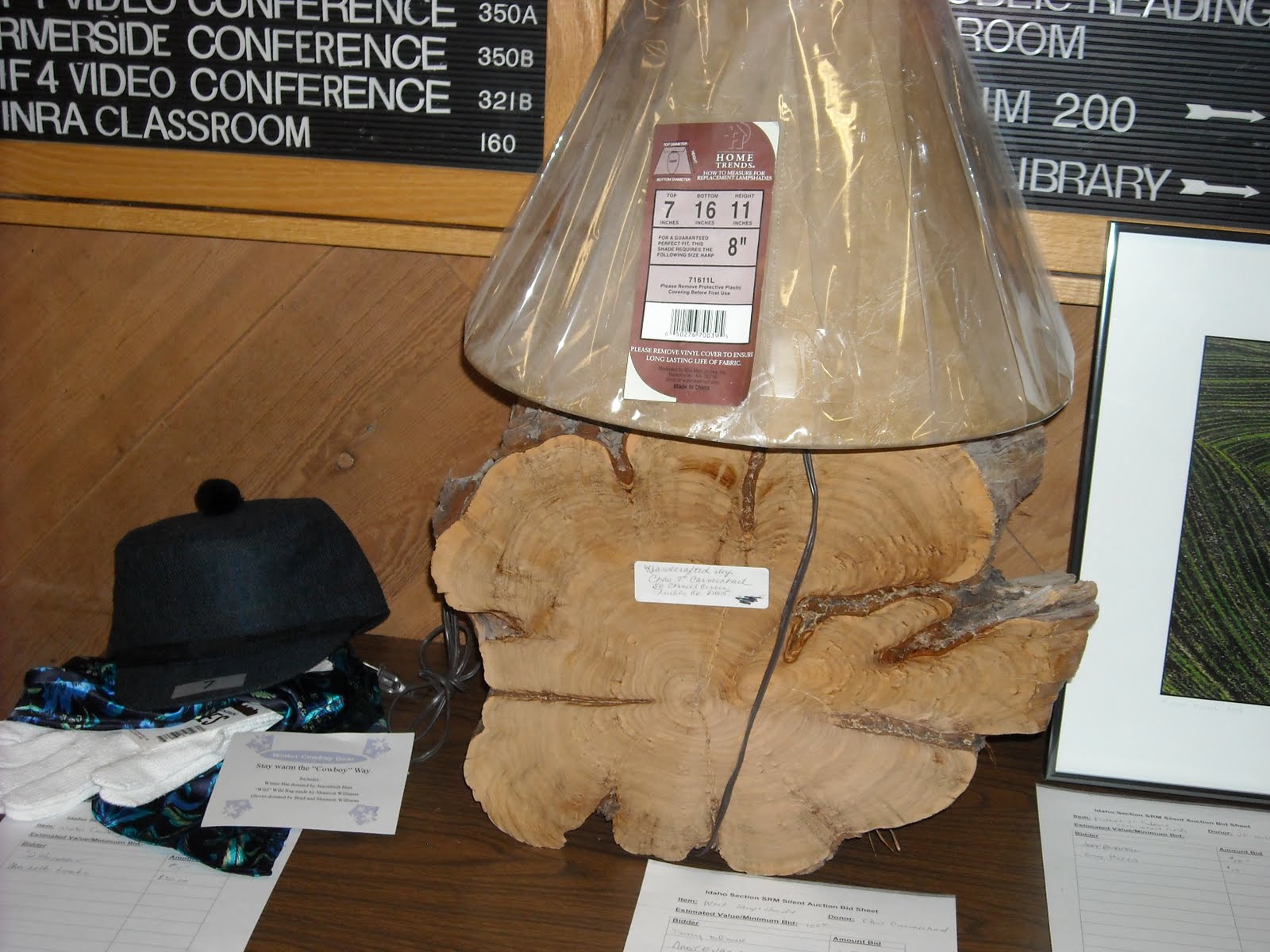
Another highlight of the meeting was the student benefit silent auction, which featured fierce bidding for such items as a license plate clock, a juniper-stand lamp, canned produce, several books, and of course a number of gift baskets. Proceeds from this annual event go to the Brian Miller Scholarship fund and donations to other student groups. Winners were declared during the Friday lunchtime poster session.
I also had the opportunity to catch up with incoming section president Roger Blew, so be sure to keep posted for the next SRM Spotlight!
Overall, thanks to Idaho for a terrific experience. The meeting was a huge success with plenty of good fun, food, and friends to offset a great atmosphere for learning. We're well on track with planning for Spokane 2012... but first, I'll see you all in Billings!