By Les Owen, New Mexico Section
The New Mexico Section of the Society for Range Management held its Summer Tour on July 22, 2011 at the NMSU Corona Range and Livestock Research Center. Ranch Superintendent, Shad Cox, started the day off with an overview of operations on the 42 section ranch located in central New Mexico. The CRLRC is a unique research facility in that research and ranch operations are funded by commercial livestock production (cattle and sheep) and hunting opportunities on the ranch. A large collection of research literature is available on the CRLRC website.
The first stop was in a pasture where juniper was mechanically controlled in the late 1970s. Dr. Andrés Cibils is leading a research project using very large scale aerial photography and specialized software to analyze re-invading juniper sapling density effects on grass production. Preliminary data indicate that when sapling size reaches 1 meter cover, grass production decreases significantly.
Stop 2 was in a pasture where roughly half was open grassland and half juniper woodland. GPS collars were fitted on cattle and mule deer to determine habitat preference for each species based on tree densities, time of year, and climatic conditions. Data show that both mule deer and cattle start to avoid woodland areas when canopy cover exceeds 40%.
The third site was an area where an intensive targeted grazing study was conducted using goats and sheep to control juniper saplings. Results only indicated a 5% kill on saplings, with most controlled individuals being smaller in size. The majority of the saplings were too large and established for the targeted grazing to be highly effective. Targeted grazing can be an effective tool for managing juniper saplings that are small and could be a good complementary tool with other control mechanisms.
Just before lunch we visited a half section pasture where re-invading juniper was controlled using individual plant treatments of Velpar. Around 95% control was achieved for close to $9.50 per acre application cost. The CRLRC employed the services of the NMSU Range Club to apply the treatment which resulted in good experience for the students and an effective control for the CRLRC. Tour Sponsor and DuPont Representative, Jack Lyons, provided information about placement of soil application of Velpar in relation to the edge of the juniper drip line.
Lunch was served at the almost completed Southwest Center for Rangeland Sustainability located near the center of the ranch. Shad Cox provided a tour of the new facility which will serve as a centrally located venue in New Mexico for educational programs related to agriculture. The facility houses a classroom, conference room, offices, and a commercial kitchen. Look forward to hearing of many more great programs being hosted at this facility.
After lunch we moved on to a site where individual juniper plants in plots received either a foliar application of Surmount or tree drip line application of Tordon. Tour Sponsor and Dow Representative, Greg Alpers, provided information about the applications and emerging technology using electrostatically charged herbicide to vastly improve efficacy of aerial treatments. Trials have been conducted on mesquite and cholla with promising results.
Next a research project using VLSA photography to estimate juniper biomass for use as a biofuel was visited. After the photography was acquired, each juniper was individually harvested, mulched and weighed to calibrate the estimation tool. This was done on two separate plots where about 50 tons of biomass was harvested. Researchers are able to use data from this project to accurately estimate standing juniper biomass using VLSA photography. Note in the picture background a strange phenomenon having to do with darkening skies that has been rumored to happen in the past around New Mexico.
Our 7th stop of the day was a hydrology study in juniper woodlands where soil moisture sensors were placed in replicated plots where Spike had been used to control juniper and control plots. Data showed a 3 fold increase in grass production in treated plots, but due to the low average rainfall neither control or treated plot soil sensors indicated moisture penetration that would lead to aquifer recharge.
Our final stop of the day was to a study where Spike was used to control juniper in the mid 1990s and Rx fire was used as a follow up treatment in 2003 to control emerging saplings. Differences in forage production between the pasture where the Spike treatment was followed with Rx fire and that without fire was significant. Sapling emergence in the non-burned pasture caused a decrease in grass production.
The NMSRM Summer Tour had a great tour and we are very appreciative to NMSU and the Corona Range and Livestock Research Center for hosting the event. We also would like to thank our tour sponsors: Dow, DuPont, and NorthStar Helicopters.
Showing posts with label Native Species. Show all posts
Wednesday, July 27, 2011
Wednesday, July 6, 2011
High Desert Youth Range Camp Celebrates 1st Successful Year!
By Brenda Smith, Pacific Northwest Section
An extraordinary tradition that has been dormant for many years was renewed when 16 high-school age students from across Oregon and Idaho gathered June 19th-23rd for the first annual High Desert Youth Range Camp at the Northern Great Basin Experimental Range (NGBER) 40 miles west of Burns, OR. Well over a year ago a range camp committee made up of ARS scientists, Oregon State Cooperative Extension specialists, Treasure Valley Community College instructors and Harney County school district science teachers organized to develop the curriculum and logistics to host the camp at the 16,000 acre rangeland owned by the USDA-ARS. All told volunteers from nine agencies and local ranches committed their expertise and time as camp counselors, instructors, cooks to direct activities for the 4 day camp. The camp staff and presenters were all absolutely outstanding and put a tremendous amount of work and sacrifice to make range camp in Oregon a reality. The Pacific Northwest Section of SRM board of directors was instrumental in supporting the camp and provided a substantial financial donation to see range camp get off to a good start. A number of conservation districts and even private ranchers supported scholarships for students to attend.
| Group Photo |
An extraordinary tradition that has been dormant for many years was renewed when 16 high-school age students from across Oregon and Idaho gathered June 19th-23rd for the first annual High Desert Youth Range Camp at the Northern Great Basin Experimental Range (NGBER) 40 miles west of Burns, OR. Well over a year ago a range camp committee made up of ARS scientists, Oregon State Cooperative Extension specialists, Treasure Valley Community College instructors and Harney County school district science teachers organized to develop the curriculum and logistics to host the camp at the 16,000 acre rangeland owned by the USDA-ARS. All told volunteers from nine agencies and local ranches committed their expertise and time as camp counselors, instructors, cooks to direct activities for the 4 day camp. The camp staff and presenters were all absolutely outstanding and put a tremendous amount of work and sacrifice to make range camp in Oregon a reality. The Pacific Northwest Section of SRM board of directors was instrumental in supporting the camp and provided a substantial financial donation to see range camp get off to a good start. A number of conservation districts and even private ranchers supported scholarships for students to attend.
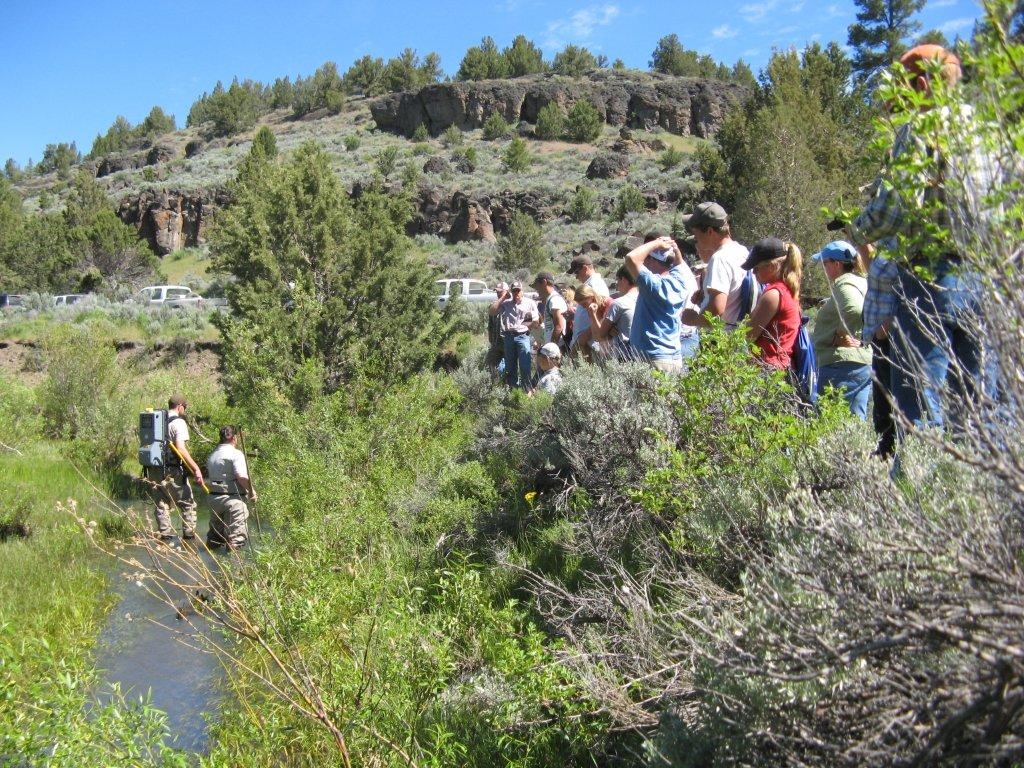
| Riparian Studies |
| Top of the World (or a Butte) |
Activities included map reading, GPS, compass and orienteering, soils investigation activities, plant identification and monitoring, interactions of fire, grazing and weeds, Juniper woodland investigations, wildlife presentations on mule deer and sage grouse, a visit to the nearby Hotchkiss Co. Ranch, riparian zone investigations, student team presentations, daily team building and leadership activities, and more. The students in attendance were interested, engaged, and adventurous and worked extremely well together. It was a downright “fun” learning experience. The top student selected to attend the SRM High School youth forum is Isaac Studtmann from Long Creek, OR. Just a few of the comments received from the students include “I feel that I have taken so much out of this camp and could see myself working in this field”, “I feel so much more informed about issues with rangeland management. I am now considering a career in rangeland management much more now!” and “Overall I think camp went very well and I am happy I came. Thanks for doing this for us.”
We all are very excited to have a range camp back in Oregon and look forward to keeping the renewed tradition going and growing.
| Soil tests |
Tuesday, April 5, 2011
Our Juniper Story is Told
Click here to watch this excellent video about western juniper and featuring SRM members Doc and Connie Hatfield, Dr. John Buckhouse, Tim Deboodt, Michael Fisher and Hugh Barrett
Guest Post by Hugh Barrett, SRM Pacific Northwest Section
Following a friend’s communication with Oregon Public Broadcasting inquiring about their interest in doing a program on western juniper in Oregon, I received a call from Vince Patton, Producer of Oregon Field Guide – OPB’s popular weekly outdoor program. He told me that during his trips to eastern Oregon he’d always wondered why “ranchers were cutting all that juniper”. As we talked, Vince seemed increasingly interested in producing a segment for the program. Subsequently, I sent an email to Vince that contained links to several publications on western juniper and the names and contact information for several scientists, ranchers and others who also are deeply involved in the juniper issue.During several phone conversations I had with Vince over the next few months, I laid out the story of juniper in the inter-mountain environment. His interest grew as I described the steps and mis-steps leading to the rapid expansion of juniper’s range; its impacts on the sagebrush biome; and, its influence on watershed function and western aridity. On a windy mixed rain-and-snow afternoon about three months after our original phone conversation, we met in Doc and Connie Hatfield’s living room at their High Desert Ranch near Brothers, Oregon. Fortifying ourselves against the cold with bowls of hot chili and warm corn bread, we planned the process for the next two days filming.
That’s how it all came together. I hope the program speaks for itself.
Click here to watch the video
![]() |
| 50 acre juniper control/watershed repair project in Klamath County, Oregon (before treatment) |
Tuesday, November 16, 2010
Idaho Section Meeting
By Julia Workman, SRM Outreach Intern

The Idaho SRM Section’s 2010 winter meeting on November 10-12 featured several talented speakers at various symposia focused on “Alternative Management Strategies in Big Sagebrush Steppe: Perspectives, Opportunities, and Supporting Evidence.” The section co-hosting Spokane 2012 showed the 150 visitors to Idaho Falls a great learning experience and plenty of opportunity for Idaho section members to get to know each other and guest Aleta Rudeen, the national organization’s Director for Outreach and Leadership.
The meeting kicked off with the business meeting on Wednesday night. Karen Launchbaugh, a professor at the University of Idaho, talked about the new UI Rangeland Center. This program, the only one like it in the West, currently has a membership of 23 professors, agency workers, and other individuals interested in rangelands. It will focus on applied research and forming longterm relationships, as well as solidifying the importance of rangeland ecology and management through times of shifting values at the university. Meribeth Lomkin also took the spotlight as she received the Traveling Outhouse Award for the second year running (which was handy, since the outhouse had forgotten to travel to the m
eeting).
The Thursday and Friday seminars kicked off with “Sagebrush steppe ecosystems—musings of a long-term student,” followed by talks ranging in topic from “Understanding resistance to invasion and resilience to disturbance” to “Fire ecology of sagebrush systems: to burn or not to burn for wildlife habitat,” from “Remote sensing applications in the sagebrush steppe of Idaho” to “Inter-relationships of invasive and native plants and hydroclimate in sagebrush steppe: implications for management.” Needless to say, everyone’s understanding of the sagebrush ecosystem improved quite a bit during our time there.
Another highli
ght of the meeting was the student benefit silent auction, which featured fierce bidding for such it
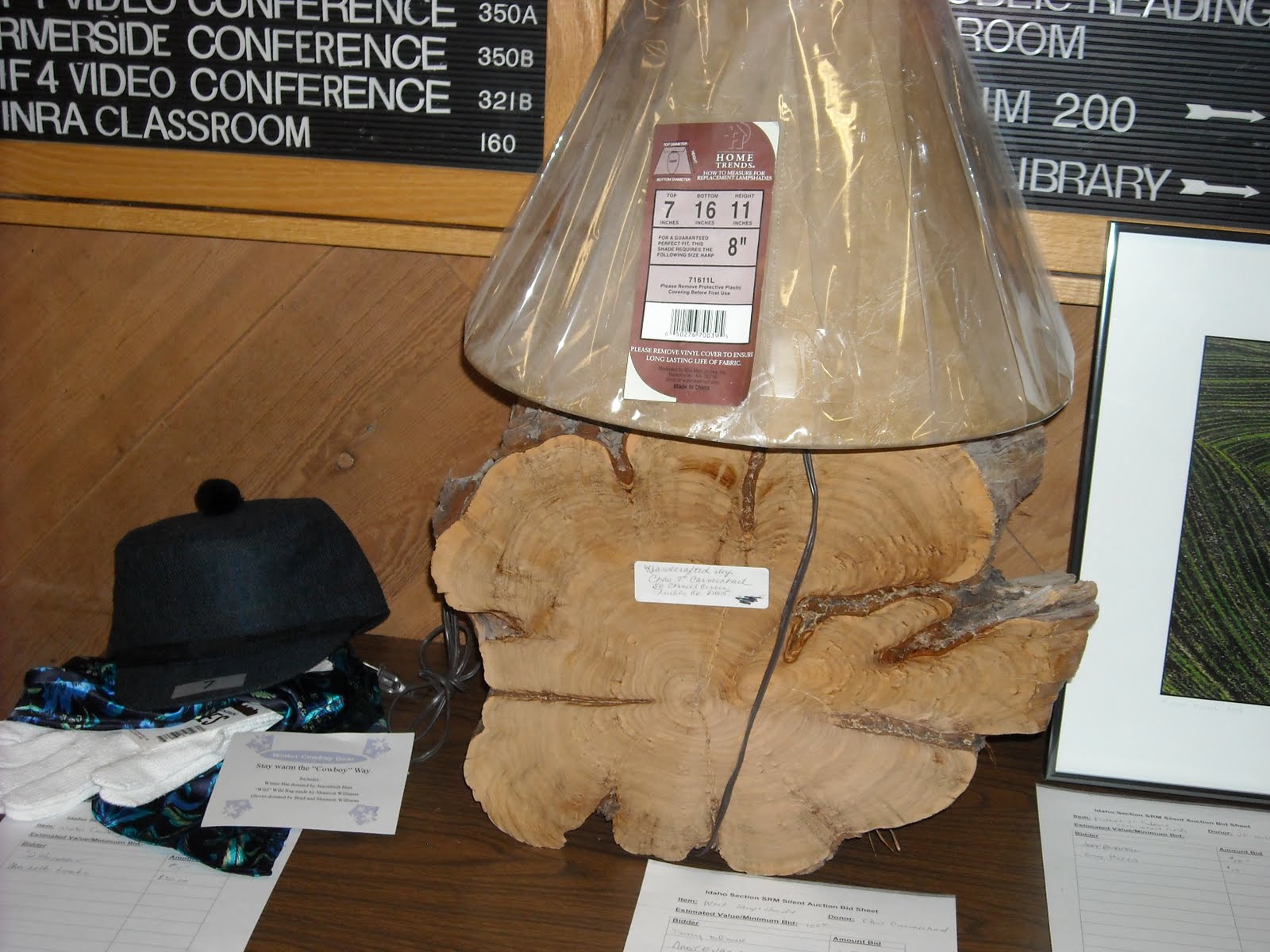
ems as a license plate clock, a juniper-stand lamp, canned produce, several books, and of course a number of gift baskets. Proceeds from this annual event go to the Brian Miller Scholarship fund and donations to other student groups. Winners were declared during the Friday lunchtime poster session.
I also had the opportunity to catch up with incoming section president Roger Blew, so be sure to keep posted for the next SRM Spotlight!
Overall, thanks to Idaho for a terrific experience. The meeting was a huge success with plenty of good fun, food, and friends to offset a great atmosphere for learning. We're well on track with planning for Spokane 2012... but first, I'll see you all in Billings!
Thursday, October 21, 2010
SRM Spotlight: Lynne Breese, Pacific Northwest Section
By Julia Workman, SRM Outreach Intern
For ranchers Lynne Breese and her husband John of Prineville, Oregon, membership in the Society for Range Management is about being part of a big family. “It’s like going to a family reunion,” she says of attending SRM functions. Members “don’t always agree, but we can learn from each other and we’ve become such good friends, we can work out problems together.” Since joining the organization in the early 90s, Lynne has certainly been involved in that family.
Lynne was raised in an agricultural setting, with a father who worked as a researcher at the Oregon State University Agricultural Experiment Station in Ontario. She also participated in 4-H, an experience which would later lead her to a home economics degree and a career as an extension agent with Oregon State University.
Lynne joined SRM in the early 1990s, about the time she took a role in the full-time management of the ranch. She says that then as now, it was important to both her and her husband (who had joined a few years before) that SRM provided them a medium for meeting people with a variety of experiences on rangelands, and allowed them the opportunity to learn more about the things they wanted to do with the ranch.
John and Lynne’s ranch has been in the family for well over a century, since John’s great-grandfather homesteaded it in the late 1880s. She notes that in photos of the original homestead, there is a conspicuous lack of invasive junipers. Juniper control is thus an important part of the couple’s management. She relates how she and John often host student groups who come to “learn on the land,” by working on the ranch: “they help cut little junipers to eat,” she explains with a chuckle, noting that all parties seem to benefit from the exchange. The different activities these students engage in during their time on the ranch are important learning events for all participants, and Lynne believes such events to be one of the best ways for young members to learn from older ones. Especially in light of current workforce trends away from agricultural backgrounds, Lynne emphasizes that students need to “get out and get their hands and feet dirty” in order to learn. They need to work with those who live and work on the land in order to gain a practical knowledge of the field. “You don’t do that by sitting at a computer,” she adds, also noting that agencies and retirees are great resources to tap for gaining this sort of experience.
However, hosting student groups is just one example of the Breeses’ participation in SRM. Lynne has served as director of the Pacific Northwest Section and is currently a co-editor for the Pacific Northwest Section newsletter. John and Lynne also frequent various SRM events, from conventions to workshops. Lynne remarks that participation is crucial to the continued success of the organization, along with members’ willingness to talk and listen to each other. “Don’t be afraid to ask questions,” she cites as the best advice she has ever received, “but do be willing to listen.”
Lynne’s vision for SRM involves an organization that “continues to do what we do.” She notes that the need for practical range management skills is not going to go away; if anything, it will only become greater. Society for Range Management members should thus be prepared to reach out to potential new members through agencies and personal invitations, with an ability to explain SRM’s relevance to all stakeholders—both those who manage the land and those who benefit from its successful management.
![]() |
| Lynn (with Bonnie and Kippy) monitoring a prescribed range burn |
For ranchers Lynne Breese and her husband John of Prineville, Oregon, membership in the Society for Range Management is about being part of a big family. “It’s like going to a family reunion,” she says of attending SRM functions. Members “don’t always agree, but we can learn from each other and we’ve become such good friends, we can work out problems together.” Since joining the organization in the early 90s, Lynne has certainly been involved in that family.
Lynne was raised in an agricultural setting, with a father who worked as a researcher at the Oregon State University Agricultural Experiment Station in Ontario. She also participated in 4-H, an experience which would later lead her to a home economics degree and a career as an extension agent with Oregon State University.
Lynne joined SRM in the early 1990s, about the time she took a role in the full-time management of the ranch. She says that then as now, it was important to both her and her husband (who had joined a few years before) that SRM provided them a medium for meeting people with a variety of experiences on rangelands, and allowed them the opportunity to learn more about the things they wanted to do with the ranch.
John and Lynne’s ranch has been in the family for well over a century, since John’s great-grandfather homesteaded it in the late 1880s. She notes that in photos of the original homestead, there is a conspicuous lack of invasive junipers. Juniper control is thus an important part of the couple’s management. She relates how she and John often host student groups who come to “learn on the land,” by working on the ranch: “they help cut little junipers to eat,” she explains with a chuckle, noting that all parties seem to benefit from the exchange. The different activities these students engage in during their time on the ranch are important learning events for all participants, and Lynne believes such events to be one of the best ways for young members to learn from older ones. Especially in light of current workforce trends away from agricultural backgrounds, Lynne emphasizes that students need to “get out and get their hands and feet dirty” in order to learn. They need to work with those who live and work on the land in order to gain a practical knowledge of the field. “You don’t do that by sitting at a computer,” she adds, also noting that agencies and retirees are great resources to tap for gaining this sort of experience.
However, hosting student groups is just one example of the Breeses’ participation in SRM. Lynne has served as director of the Pacific Northwest Section and is currently a co-editor for the Pacific Northwest Section newsletter. John and Lynne also frequent various SRM events, from conventions to workshops. Lynne remarks that participation is crucial to the continued success of the organization, along with members’ willingness to talk and listen to each other. “Don’t be afraid to ask questions,” she cites as the best advice she has ever received, “but do be willing to listen.”
Lynne’s vision for SRM involves an organization that “continues to do what we do.” She notes that the need for practical range management skills is not going to go away; if anything, it will only become greater. Society for Range Management members should thus be prepared to reach out to potential new members through agencies and personal invitations, with an ability to explain SRM’s relevance to all stakeholders—both those who manage the land and those who benefit from its successful management.
Subscribe to:
Posts (Atom)