Showing posts with label Federal Agency. Show all posts

Wednesday, July 6, 2011

High Desert Youth Range Camp Celebrates 1st Successful Year!

By Brenda Smith, Pacific Northwest Section


Group Photo

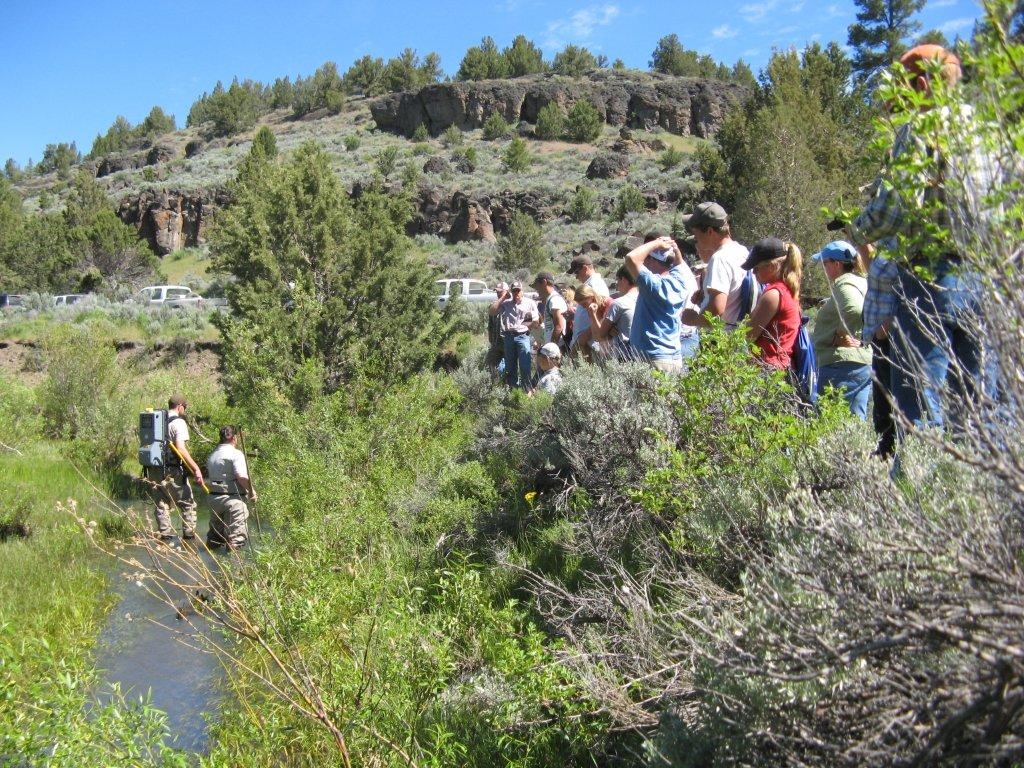
An extraordinary tradition that has been dormant for many years was renewed when 16 high-school age students from across Oregon and Idaho gathered June 19th-23rd for the first annual High Desert Youth Range Camp at the Northern Great Basin Experimental Range (NGBER) 40 miles west of Burns, OR. Well over a year ago a range camp committee made up of ARS scientists, Oregon State Cooperative Extension specialists, Treasure Valley Community College instructors and Harney County school district science teachers organized to develop the curriculum and logistics to host the camp at the 16,000 acre rangeland owned by the USDA-ARS. All told volunteers from nine agencies and local ranches committed their expertise and time as camp counselors, instructors, cooks to direct activities for the 4 day camp. The camp staff and presenters were all absolutely outstanding and put a tremendous amount of work and sacrifice to make range camp in Oregon a reality. The Pacific Northwest Section of SRM board of directors was instrumental in supporting the camp and provided a substantial financial donation to see range camp get off to a good start. A number of conservation districts and even private ranchers supported scholarships for students to attend.
Riparian Studies
Top of the World (or a Butte)

Activities included map reading, GPS, compass and orienteering, soils investigation activities, plant identification and monitoring, interactions of fire, grazing and weeds, Juniper woodland investigations, wildlife presentations on mule deer and sage grouse, a visit to the nearby Hotchkiss Co. Ranch, riparian zone investigations, student team presentations, daily team building and leadership activities, and more. The students in attendance were interested, engaged, and adventurous and worked extremely well together. It was a downright “fun” learning experience. The top student selected to attend the SRM High School youth forum is Isaac Studtmann from Long Creek, OR. Just a few of the comments received from the students include “I feel that I have taken so much out of this camp and could see myself working in this field”, “I feel so much more informed about issues with rangeland management. I am now considering a career in rangeland management much more now!” and “Overall I think camp went very well and I am happy I came. Thanks for doing this for us.”

Soil tests
We all are very excited to have a range camp back in Oregon and look forward to keeping the renewed tradition going and growing.

Tuesday, May 24, 2011

Save the Date: Ecological Site Description Training Workshops

ESD - Save The Date
Ecological Site Description (ESD) Training Workshops

Society for Range Management (SRM) has been moving forward with the planning of additional ESD training workshops following the successful Pilot Interagency Range ESD Workshop in November 2010. We are excited to announce that three regional based efforts are currently under development.

The following information is intended to briefly update interested parties on these upcoming workshops. More information on agendas and accommodations will be forthcoming in the near future. Website information updated regularly. Registration will be on a first-come first-served basis and should be live no later than end-of-June 2011.

Please note that the workshop under planning for Reno, NV - August 2-4, 2011 - is now RESCHEDULED for June 2012.

Details for a second workshop scheduled for August 23-25, 2011 in Cheyenne WY are provided below.

Also note that a third workshop is under planning for Florida in early November 2011. 


INTERAGENCY ECOLOGICAL SITE APPLICATIONS WORKSHOP
Cheyenne WY/Nunn CO
23-25 August 2011

For registration and lodging questions, please contact:
Aleta Rudeen
SRM Director of Outreach and Leadership Development
arudeen@ranglands.org
(303) 720-2715

For all other questions, please contact:
Linda Coates-Markle
BLM Liaison to SRM
lcmarkle@rangelands.org
(303) 986-3309

Monday, May 23, 2011

2011 SRM Fly-In, Washington D.C.

Guest post by Gary Frasier, SRM First Vice President


2011 Fly-In
Washington D.C.

SUMMARY REPORT


2-5 May 2011 

Participants: 
Jack Alexander, SRM President
Gary Frasier, SRM 1st Vice President 
Wally Butler, SRM 2nd Vice President
Aleta Rudeen, SRM Director of Outreach and Leadership Development 
Kimberly Haile, SRM Young Professional
Jess Peterson, SRM Executive Vice President
Kelly Fogarty, SRM Washington D.C. Liaison 

The Society for Range Management (SRM) executive committee travels to Washington D.C. each year.  The purpose of this trip is to converse with SRMs partners about current and past projects and to identify their current training needs and how SRM can help them meet those needs and maintain its role as an professional society for its members.

The Spring, 2011 Washington Fly-In consisted of two full days of short meetings with various Federal Agencies, (Bureau of Land Management, Natural Resources Conservation Service, U.S. Forest Service, and US Department of Agriculture officials), Sister Societies (The Wildlife Society, American Fisheries Society, Society of American Foresters), and commodity organizations (Public Lands Council, American Sheep Industry).  There was also a Reception by Western Skies Strategies (Jess Peterson) and a 2011 American Lamb BBQ hosted by the American Sheep Industry.


Under the leadership of SRM President Jack Alexander, discussions with each group centered on the Ecological Site Description Workshops facilitated by SRM, Training and Certification opportunities, and Native Range Forums, past and upcoming. 

We were well received by all groups. SRM is perceived as a credible science-based organization.  The discussions were very open with the dialog directed toward how we could all work more closely to achieve the goals of proper management of natural resources, especially during these times of reduced budgets. 

The Fly-In was considered a successful activity of getting to better know the “Washington Scene” and to expose the various groups we met with to SRM’s goals and objectives.

Monday, January 24, 2011

Native Range Session at the 64th Annual Meeting in Billings, Montana

Guest post by Diana Doan-Crider


On February 10, 2011, the SRM will be hosting a special one-day Native Range Session during the 64th Annual Meeting in Billings, Montana, to discuss RANGE MANAGEMENT ON TRIBAL LANDS.

The United States Government holds 55.7 million acres of land in trust for Native Americans, of which much is considered to be rangeland.  Native vegetation on the rangelands provide habitat for native wildlife and livestock, and provide other resources needed for a high quality life for the Native Americans.  Dynamic and high quality management of rangelands is essential for the success of the Native American communities.  Successful management of the rangelands, which includes a wide variety of resources, must not be focused on a single objective but rather on achieving a wide variety of habitat objectives that best meet the social, cultural, economic, and physical needs of the tribe.

Rangeland management practices and needs vary on the numerous reservations, ranging from livestock that is owned by non-member individuals or corporations, or by individual tribal members and livestock cooperatives.  Range management programs also vary widely between tribes.  In some cases, the Department of the Interior - Bureau of Indian Affairs (USDI-BIA), develops range management plans.  Some reservations, however, manage their own rangelands through the tribe’s Natural Resources Department.  It other cases, tribes receive assistance through liaisons appointed by the US Department of Agriculture’s Natural Resources Conservation Service (USDA-NRCS).
The Society for Range Management’s mission is to promote the professional development and continuing education of members and the public and the stewardship of rangeland resources.  The Native American Range Initiative involves partnerships with tribes and the various federal agencies involved in range management in order to achieve this mission.  Recognizing the numerous changes that have and are occurring in the management and use of the Native American rangelands, the Society is sponsoring this workshop to discuss the various challenges and needs for range management on tribal lands, training opportunities, and education of future tribal range managers.  This session offers the opportunity to see how the Society’s programs and broad membership might partner to help serve the needs of Native American rangeland communities, including the managers and those who depend on the rangelands.

We are inviting both tribal members and conference participants who are directly involved with range management on tribal lands to participate in this workshop.  The SRM conference DAILY registration fee of $80 has been sponsored for up to 25 tribal members for this session; there is no additional charge for regular conference participants.  A brainstorming period will follow, so we ask that participants attend for the entire duration of the session.  Attendance is limited; lunch is not included.  The workshop will be hosted from 8:00 am – 5:00  pm at the Billings Hotel and Convention Center – specific location will be announced on site.  For more information or to sign up, please contact Diana Doan-Crider at http://www.blogger.com/d-crider@tamu.edu, or call (830) 431-2770.

Friday, January 14, 2011

Upcoming Symposium: Breaking the Current Fire Cycle, February 1-2, 2011

Guest post by Neil Rimbey, Idaho Section

Burning Rangeland
The Boise District BLM Resource Advisory Council, the Society for Range Management, the Agricultural Research Service, Natural Resources Conservation Service and others are sponsoring a Symposium on February 1-2, 2011 in Boise, Idaho. “How Can Resource Management Break the Current Fire Cycle?” is designed to identify fire, fuel and vegetation management methods appropriate for conserving high value and degraded Wyoming Sagebrush steppe habitats by reducing fire frequency. The session will be highlighted by the Keynote Address by Dr. Jim Young, author of the recent book, Cheatgrass: Fire and Forage on the Range. Jim will summarize over 40 years of research on the ecology, management and control of cheatgrass. This background information will set the stage for jumping into 5 key questions:
  1. Given the opportunity to develop major, strategic fire breaks, what kinds of fuel breaks would be effective and affordable to create, maintain and persist?
  2. What other kinds of fuel breaks and tools can be used most effectively in areas with frequent wildfires and areas which still maintain Wyoming sagebrush stands?
  3. In light of listings of threatened or endangered species in the sagebrush steppe system, is a fuel reduction program feasible and what suitability criteria, mitigation and administrative procedures will allow for its establishment?
  4. How can various fuel reduction tools be coordinated across land ownerships to facilitate the next step of rangeland rehabilitation?
  5. What monitoring and management protocols can be established to ensure that we achieve short-, intermediate- and long-term goals associated with fuel management, decreasing fire frequency and rangeland rehabilitation?
These questions will be explored by panels of experts and practitioners associated with each area. They will involve active audience participation through questions and dialog.

The session will be held at the Washington Group International Conference facility (800 Park Blvd.) in the heart of downtown Boise. More information is available via the following website:
http://www.blm.gov/id/st/en/res/resource_advisory/boise/boise_district_rac.html

Additional questions? Contact Neil Rimbey (208-454-6566 or nrimbey@uidaho.edu), or Ted Hoffman (208-587-6374 or brokeno@mindspring.com )

Fire

Thursday, January 6, 2011

SRM Spotlight: Marilyn Samuel, Florida Section

By Julia Workman, SRM Outreach Intern


Marilyn Samuel of the Florida Section has a unique claim to fame: she was the first woman elected to SRM’s Board of Directors, in 1987. A retired botanist, Marilyn has seen SRM and rangeland management come a long way since the days when she was often mistaken for “someone’s wife” at Society events.

Marilyn grew up in California and in high school moved to Wyoming, where she graduated from Cheyenne High School. She then attended the University of Wyoming in Laramie for her Bachelor’s degree in Zoology and her Master’s in Botany. She spent some time after graduation at the High Plains Grasslands Research Station breeding strawberries and tomatoes and doing other botanical work. In 1974, she says, she “fell into” a new direction more suited to her degree when the Field Station changed its mission to focus on grasslands research. Marilyn took a few plant identification classes to learn the native species and began her career in rangelands. Before long, she was monitoring plant responses to animal grazing with the United States Department of Agriculture (USDA).

Joining SRM, Marilyn says, “was the thing to do after I joined range research.” When she did so, around 1975, she was one of few woman professionals at the meetings, although there were quite a few female students. After getting involved in publicity for the 1979 Annual Meeting in Casper, Wyoming, she says, “things seemed to snowball along.” She was also involved with publicity for the 1986 Annual Meeting in Jackson Hole, Wyoming, and served as the Chair of the SRM Information and Education Committee.

Marilyn attributes her election to the parent Society Board of Directors to name recognition. In her role with publicity, she says, she was “in everyone’s face for awhile,” plus known for being one of the few professional women in the Society. After being defeated once, she ran again for the Board with her supervisor’s support (“The upper level told me, ‘You will run again,’” she laughs). This time, she was elected to a role that she enjoyed very much. Marilyn says it was a lot of work and a lot of reading, but it was rewarding to be involved in making big decisions for SRM.

Marilyn is now retired and resides in Florida, where she serves as the Florida Section Newsletter Editor and Section Webmaster. She has some interesting insights on how rangeland management has changed since the seventies. Marilyn says that women have been acknowledged for what they can bring to SRM. She references the way she finally “divorced herself from her boss” at professional meetings so people would stop assuming that the two were a married couple.

As women became bigger players in the Society, Marilyn recalls, there was an emphasis on programs specifically for the ladies. Eventually, men were incorporated into these so that there is no longer the male versus female setup. Men and women still have different needs, she acknowledges, but programs are now geared toward being applicable to both sexes.

Marilyn says the best thing about the Society for her career was that it gave her the ability to make connections with researchers whose work she had read. That ability to talk to them and even grow close to some was all a part of the Society’s close-knit, family feeling.

Marilyn believes that SRM will continue to grow by maintaining its diversity and catering to diverse interests. She also advises young members to get involved by volunteering for committees “at whatever level they’re comfortable,” whether the chapter, section, or parent Society level.

Tuesday, December 21, 2010

SRM Spotlight: Tate Lantz, South Dakota Section

By Julia Workman, SRM Outreach Intern


South Dakota native Tate Lantz is a fan of the producer forums that were held at the Denver Annual Meeting last year. Their value is “a no brainer,” he says, adding that these forums were “at least as well attended as any of the others.” He believes that reaching out in this way to producer-oriented groups and landowners will go a long way toward making these members feel more comfortable in a Society that he believes has moved more toward academia since he joined over twelve years ago.

Tate grew up on a ranch in central South Dakota, raising both cattle and crops. Even after graduating from South Dakota State University and ending up with the Natural Resources Conservation Service (NRCS), he still enjoys being able to go home and work on the family ranch. Now a Rangeland Management Specialist with the NRCS Rapid City Field Office, Tate also enjoys skiing and snowboarding and, he laughs, “I seem to hunt more than my wife likes!” Tate joined SRM when he first went to work with the NRCS in 1998; he recently finished his term on the South Dakota Section SRM Board of Directors and is also the current Awards Committee Co-Chair for his Section.

The NRCS, Tate says, encouraged him to get involved in SRM by helping new employees to attend conferences and other events. However, it is the connections he has made that have kept him a member of the Society. “You can’t get these benefits anywhere else,” he remarks. The people he has met and the ability to contact them with questions have been instrumental in his career. He adds that SRM has improved younger members’ opportunities to open those lines of communication. When Tate was first starting his career, he says, “you’d just start a conversation when you were sitting next to a guy at the bar.” Now, programs like the Tapping the Top Mixer at Annual Meetings make building relationships a lot easier.

Tate recommends that young members attend the International Meetings and talk to people while there. He adds that younger members should simply introduce themselves if they want to learn more about a topic of discussion between other members, saying that “most will let you right in” to the conversation. The whole meeting, he believes, is a great place to foster relationships between generations. He suggests that older members get to know one or two younger people and stay in contact with them to mentor to them through their careers. He also counsels younger members to actively seek out experienced members and take them on as mentors to coach them through their careers. “It would be nice [for these members] to have… a go-to person,” he explains.

Such connections are especially important in these transitional times. Tate comments that even locally, he sees more NRCS professionals retiring than are starting with the agency. This will be an issue down the road as access to fewer employees places more stress on projects and the workforce. However, it also means that there will be a lot of job openings and opportunities for professionals. Tate observes that SRM seems to be doing well at getting and keeping young people involved, and suggests that it help keep these members abreast of new job opportunities.

Tate’s vision for SRM involves more diversity. He says the different groups— “the producer, the rancher, the hunter, the birdwatcher, and the [academic]—they all need to be involved.” He wants the Society to maintain its activity in rangeland management and hopes that events such as the Annual Meeting will move closer to “the heart of real-life ranching” so that landowners would be better able to attend. Tate believes that the Society will continue to thrive by better incorporating land managers and producers into its ever-changing face.

Monday, November 29, 2010

Interagency Rangeland ESD Pilot Workshop

 
The Interagency Rangeland Ecological Site Description (ESD) Pilot Workshop was held November 16 - 18, 2010 in Las Cruces, New Mexico.  The workshop was a huge success with over 85 participants and three full days of excellent presentations and valuable discussions.  The Pilot Workshop convened technical leadership from the Natural Resources Conservation Service, Bureau of Land Management, and US Forest Service, and was held at the Agricultural Research Service Jornada Experimental Range.

One primary objective of this workshop was to generate interest and support for a continuing interagency collaborative approach in the employment and utility of ESDs as well as for subsequent field-level training workshops. SRM is pleased to be in a position to support these ground-breaking efforts and is committed to moving forward with end products from the Pilot Workshop and next steps.  SRM is particularly excited to be a major player in the development of subsequent field level training workshops targeted for late Spring/early Fall 2011.  These subsequent workshops are intended to embrace a much broader audience including the entire SRM membership as well as non-members. Instructors for these workshops will not be limited to federal employees, but will encompass the larger knowledge base from university scientists, private consultants and other interested parties. 

Workshop objectives were to:

  1. Provide an in-depth background on the fundamentals of ecological sites and descriptions.
  2. Increase the understanding of current and emerging policy and science on how to define ESD's and develop ESD projects.
  3. Explore collaborative applications of ESDs to decision-making across a variety of state-level (regional) scenarios.
  4. Scope preliminary plans for moving forward with agency implementation at the field level.

To meet these objectives, the Pilot Workshop included a variety of presentations on ESDs and the interagency approach to their development and use.  The middle of the workshop included an informative field tour, which was useful in linking the scientific concepts of ESDs to what ecological sites and different states might look like on the ground.  The workshop concluded with breakout sessions and an open mic session to discuss the challenges and opportunities of ESDs, and a synthesis of the workshop.

Click here to view the Pilot Workshop agenda and details.  Click here to visit the Jornada website for access to workshop presentations and materials, including PDF documents of PowerPoint presentations from the Pilot Workshop.  A special thank you to the sponsors of this Pilot Program and to all of those who were instrumental in moving this process forward.

Stay tuned for information on the subsequent training workshops.

Wednesday, October 27, 2010

SRM Spotlight: Duane McCartney, Northern Great Plains and International Mountain Sections

By Julia Workman, SRM Outreach Intern


After more than 25 years in the Society for Range Management, Duane McCartney says the best advice he ever received was from a retired scientist in Swift Current, Saskatchewan, who simply told him, “SRM is a great organization and you should join it!” Duane took these words to heart and has been deeply involved with SRM ever since.
Duane is a retired research scientist with Agriculture Canada who enjoys canoeing, cross country skiing, landscape photography, and construction. A Forage Beef Management Systems Research Scientist, he points to his early life experiences in 4-H as the first step on his path to becoming an SRM member. He later attended the University of Guelph in southern Ontario and received a degree in Animal Science before coming to Agriculture Canada. There, he researched cost-saving methods for beef and forage production in West Canada, focusing on management systems in that area. It was during the same period, in Swift Current, that Duane’s mentor, an SRM member, advised him to join the organization. Duane followed this advice and even chartered the Saskatchewan SRM section after becoming a member, at a time when the province had only a handful of SRM members.
Since then, Duane has been heavily involved both as a member of the Nominations Committee and the Awards Committee, on which he has also served as Chair. His advice for younger members who want to get the most out of their membership echoes the same principles he has followed: “The big thing is to be involved.” He recommends that students join and actively participate in their university range clubs while in college, and later in the section associated with their post-graduation location. He adds that section committees are always looking for younger member involvement, which can lead to opportunities for early career members. Further, Duane advises that involvement in field days and local tours, with the chance to interact one-on-one with older members, is a great way to learn and critical to the transfer of knowledge to the next generation.
Throughout his 25 years of involvement, Duane has seen many changes in the demographics of the Society. Membership has fluctuated some, and the younger members, such as students, have taken a larger role. He notes that now the Society has “more ladies—that’s a big one.” There is also a greater emphasis on multiuse and less on ranching now than in the past, though the ranching aspect has made a comeback in recent years. Yet, he says, the main principles are still the same; with good leadership, the Society has been able to change with the times and without altering the things most important to its membership. SRM is, as always, an excellent venue for communication among professionals and researchers, a setting for employers and prospective employees to meet, and a Society which manages to include something for everyone at the national meetings. Duane places high value on the friends from all over the world that the Society has allowed him to make, and the chances to take tours of other ecosystems—“ones I wouldn’t see in Canada.”
The SRM of twenty-five years from now, Duane hopes, will be similar to that of today—a strong organization, and an important voice for range management involving a diversity of people. He sees a big role for SRM as the focus switches from managing rangelands for livestock to managing rangelands for multiuse, and the involvement of a broad spectrum of people as it seeks to meet society’s changing needs.

Monday, October 25, 2010

Texas Section Meeting


My first ever visit to Texas was indeed, a Texas experience and a great introduction to the Texas Section of SRM.  The TSSRM fall meeting, this year held October 13-15 in Odessa, TX, is similar to a mini version of the international SRM Annual Meeting, complete with a trade show and more than 200 registrants.  While in Odessa I experienced first-hand the famed Texas hospitality...  (despite my inability to two-step).  I thoroughly enjoyed the technical sessions, banquets, and field tour.

A very large portion of the TSSRM membership is made up of NRCS employees, which is unsurprising as Texas has large amounts of private relative to public land.  Also noteworthy is that the Texas section is by far the largest section of SRM with more than 500 members.  This makes for big meetings with an interesting focus.  Additionally the meeting hosted quite a few young professionals, who had several opportunities to attend career development sessions in conjunction with the meeting, and plant ID and photo contest.

The Thursday and Friday technical sessions kicked off with a welcome from the Mayor of Odessa, and focused on a diversity of topics.  These included: effects of woody plants on water balance, effects of rangeland recovery on stream flows, mechanisms driving vegetation change, herbicides, prescribed fire to improve diversity, the challenges to range improvements, and the management of salt cedar using herbicides and biological control.  Presenters brought a wide range of experience to the technical sessions, as well as on the tour Thursday afternoon.


The tour was, as always, a meeting highlight.  On Thursday afternoon we set out in four large, air conditioned buses from the hotel heading for the local Railway Ranch.  Stan Smith, the owner of the ranch greeted us and gave an overview of the area.  Ray Schimcek gave an overview of the ranch partnerships and Dr. Dan Womochel (pictured) spoke about area geology, but not before warning the us that giving a microphone to a retired Professor of Geology could be a dangerous thing to do.

The second stop on the tour focused on vegetation, forage, and treatment of creosote and tarbush, led by Dr. Allan McGinty, Preston Irwin, and Sam Schiwart.  At the third stop of the tour Guy Bell gave an overview of the treatment of African rue, and Jim Bob Simms spoke to us about pipeline safety.  Mark Moseley gave a talk titled Forage Estimation and Grazing Stick Demonstration, after which, he distributed grazing sticks to the group.  (I was disappointed, but fairly unsurprised to have my grazing stick confiscated in airport security the following day).

One of my favorite talks from the tour was titled Feng Shui for Wildlife, during which Dr. Dale Rollins shook things up with regards to vegetation management for wildlife.  Somehow, he managed to put nearly everything in terms of baseball and gave a creative, interesting talk.

All in all, the TSSRM meeting was a successful and interesting event  The banquet was fun and entertaining, I am pretty sure the auction made a killing off both its willing and unwilling bidders (and with some top notch items for sale), and people all seemed to know one another well, despite being the largest section of the Society.

Thank you to the Texas Section of SRM for their hospitality and the introduction to Texas!  Next year I'll do my best to bring some boots.
