Showing posts with label Rangelands. Show all posts

Tuesday, August 2, 2011

Chico Basin Ranch Visit

By Maggie Haseman, Outreach Intern
Photo by: Maggie Haseman
Chico Basin Ranch Headquarters

Chico Basin Ranch is a working cattle ranch located 35 miles southeast of Colorado Springs. It is 87,000 acres of rangeland owned by the Colorado State Land Board and managed by Duke and Janet Phillips and their family. As part of my internship program with SRM, I spent two full days on the ranch helping out and learning about their operation. I went to Chico Basin Ranch not knowing what to expect and found myself having a very memorable and worthwhile experience. I have always considered myself to be a city girl and I had never even been to a ranch or thought of going to a ranch before the Phillips kindly allowed me to visit theirs. My two full days and two nights on the ranch were packed full with new learning experiences, a few minor bumps in the road, and a new found appreciation for what it means to work a ranch.

When I arrived at the headquarters on July 18th at about 5:30pm, I was greeted by three young women: two interns, Lesley and Kerstin, and the youngest child of Duke and Janet, Gracie. I was then sent in to meet Young Duke, Duke and Janet’s son. He sent me to May Camp, the home he shares with Cooper Hibbard and guests when they come, saying, “It’s very easy to find.” 

Photo by: Maggie Haseman
View of the Ranch Near May Camp

The roads are dirt and they veer off in every direction, luckily May Camp was easy to get to once you’ve already arrived. On the way, I distinctly remember thinking, “I’m lost, I’m lost, I’m lost!” and suddenly the house appeared. The house was very cute and cozy, with blue cabinets in the kitchen and thankfully, running water and electricity. They had made up a bed for me in a room off the dining room and I tried to get settled in. Around six, Cooper came in and introduced himself. We talked and got to know each other a little while he fixed dinner (beans, corn on the cob, and skillet veggies, yum!) After that I just busied myself with reading before bed time. Boy was it hot in that house!

The next day I woke up at 5:50am. Cooper took me around the ranch, to fix things and help me get used to the new setting, and he taught me a lot that day. Like I said, my ranch knowledge bucket was empty before I arrived, I learned a lot but I know my short adventure was not enough to fill it, not even close, there is so much to know. The first thing I learned was that there is something tricky you have to figure out about all vehicles you drive around the ranch, the one we were using didn’t open from the inside, another one didn’t have a windshield or doors, and a third you have to pull the door up and then close it or it will open while you drive.

After we had the truck loaded we drove for ages. 

Photo by: Maggie Haseman
View of the Ranch and Mountains
We had to check water tanks because there was something wrong with the system that Cooper had been working to fix the day before. Luckily, he succeeded, which meant it wasn’t a leak we had to find. I was shocked to find a drowned salamander and frog in one tank and tadpoles in another, it was so dry there, these critters just seemed out of place. We then went to a drained water tank to fix some holes with cement. It was only 9:00am or so and it was already hot, hot, hot! At another tank, we had to pump it dry so that Cooper could replace the water valve. It was so stinky and when Cooper asked me to get in the tank with that gooey greenish-black gunk I was very apprehensive; it turned out to not be that bad. The valve was so stuck we couldn’t get it to budge so Cooper resolved to leave it until he had some better tools.

Along the way, I was learning how to open and close fences. It seems like that should be an easy task that wouldn’t really take much to learn, but I kept closing the gate with Cooper and the truck on the right side and me stuck on the wrong side. I got a GIANT splinter from one gate and shocked by another, and my goodness did I let out a shriek at that shock. I then learned how to fix a fence and drive a fence post. Later, we drove along the fence to find where the charge was grounded; meaning the electricity of the fence wasn’t shocking at full power. We finally found it, fixed it and headed back to headquarters.

Photo by: Duke Phillips
Pikes Peak behind May Pond

I then met the third Intern, Raphael. Kerstin, Raphael and I ventured to the lake to cool down and play with some puppies (there were so many puppies, four from one mom and about seven from another). I longed to go swimming to cool down but I forgot to follow my mom’s number one packing rule: always bring a swim suit; it was probably for the best though because I would have psyched myself out by the teeny leeches I saw. It was fun to relax in the setting sun and cool my feet in the water. After a while, Cooper and I headed back to May Camp for dinner and bed.

On Wednesday I woke up at 4:00am. Cooper told me we were wrangling cattle and I was supposed to ride a horse but I kept thinking it was a joke. I had not ridden a horse since a birthday party in elementary school and what help would I be gathering cattle? But, it wasn’t a joke, and next thing I knew I stood facing Cricket the horse while she looked disapprovingly down her long nose at me. You have to learn fast once you’re on a horse: sit up straight, don’t be a sack of potatoes, hold the reins here, connect with her, trust her. Cricket had a lot of energy and spunk, and I’m pretty sure she thought she knew what to do better than I did, which is true. Duke sent Gracie, Kate, their guest from Portland, Oregon, and me off in another direction, he and about eight or nine other riders went somewhere else. So Gracie, Kate and I trotted along a fence and found a small herd of cattle coming toward us. We gathered them and followed/herded them toward a central water tank where we were meeting the others. I think they kept saying we were herding 1,500 head but to me it looked like zillions. The noise, the dust, the sun, I will never forget the way it looked. I felt transported to a different time and it was wonderful.

Photo by: Cooper Hibbard
The Dukes, Father and Son

Once the cattle were gathered we started moving them back toward headquarters. Duke showed me how to keep the line moving and we made our steady way into the corrals. In the corrals the cattle were a little scary and there was one point when I thought they were going to stampede over me, though it probably wasn’t as dangerous as it felt. Regardless, I was happy to sit to the side and watch at Duke’s instruction. As I dismounted my foot got stuck in the stirrup and down I went: aside from my bruised ego I was not injured.
Photo by: Michael Moon
Cattle Train

It was so interesting to see the professionals at work herding cattle. From what I understood they were sorting cattle by size to ship. They had so much control over the situation; it was impressive to watch, and cows are just about the funniest animals I’ve ever seen – I wish I had space to write about all the funny things I saw them do while in the corrals.

Photo by: Jonathan Tullar
Bell Park Event Center
After lunch Kerstin and I were sent down to Bell Park, the stage area. Chico Basin has been hosting concerts in the summer since the summer of 2010 and they are hoping to make it an annual event. Our task was to clean up the area for the concert on the 23rd of July. I have never done such hard work in the hot sun as I did that afternoon, but I have also never felt so rewarded by the results as I did that afternoon, when Bell Park looked much cleaner.

On Wednesday evening it was time for me to say goodbye to all the people who were so welcoming and patient with me. My stay at Chico Basin Ranch taught me about the value of a day of hard work, flexibility in new and sometimes uncomfortable situations, and the beauty of the ranching profession.

I would like to send a big thank you to all the people I met at Chico Basin Ranch during my short visit. It was an experience that I cannot compare to any other and that I will never forget.

Photo by: Maggie Haseman
Hello/Goodbye Cowboy sculpture

Friday, July 15, 2011

Interest Piece - The Pros and Cons of Wind Power on Rangelands

By Maggie Haseman, SRM Outreach Intern

CQ Researcher is a periodical that covers some of the most debated social and political topics of today. I recently read a CQ Researcher article titled, “Wind Power: Is Wind Energy Good for the Environment?” written by David Hosansky, which I found to be especially informative.  
Photo by Maggie Haseman,
 National Renewable Energy Laboratory in Golden, CO
In his article Hosansky outlines the history of how humans have harnessed the power of wind. Between 5,500 B.C.E. and 1,400 A.C.E., wind power was first employed in Southeast Asia to sail boats, and in windmills to pump water and grind grain. In the 18th and early 19th century and during the Industrial Revolution, steam began to replace wind, a well established energy source throughout Europe, as a power source. By the late 19th century, however wind reclaimed its early importance when scientists began developing windmills to bring electricity to rural areas, especially in Scotland, the United States, and Denmark. In the 1900s to 1980s most of the U.S. was reliant on nuclear energy and fossil fuels for electricity, farmers however used small windmills for irrigation pump operation. Between 1990 and present day, interest in alternative energy has increased due to rising oil prices, among other factors. Today, Hosansky cites China as the wind power world leader with a wind-energy capacity of 42 gigawatts, followed closely by the U.S. at 40 gigawatts.

A wind turbine works by capturing energy when the wind blows past the blade, there is a “lift” effect causing the blades to turn. As the blades turn, a shaft that is connected to the generator spins, creating electricity.

Wind Turbine Diagram and Parts
Blades: Every turbine usually has either two or three blades.
Rotor: The blades and the hub together are called the rotor.
Pitch: Blades are turned, or pitched, out of the wind to control the rotor speed.
Brake: A disc brake, which can stop the rotor in emergencies.
Low-speed shaft: The rotor turns the low-speed shaft at about 30 to 60 rotations per minute.
Gear box: Gears connect the low-speed shaft to the high-speed shaft and increase speeds from about 30 to 60 rotations per minute (rpm) to 1,000 to 1,800, rpm, the speed required by most generators to produce electricity.
Generator: Produces 60-cycle AC electricity.
Controller: The controller starts up the machine at wind speeds of about 8 to 16 miles per hour (mph) and shuts off the machine at about 55 mph.
Anemometer: Measures the wind speed and transmits wind speed data to the controller.
Wind vane: Measures wind direction and communicates with the yaw drive to orient the turbine properly with respect to the wind.
Nacelle: Contains the gear box, low- and high-speed shafts, generator, controller, and brake.
High-speed shaft: Drives the generator.
Yaw drive: Keeps the rotor on upwind turbines facing into the wind as the wind direction changes.
Yaw motor: Powers the yaw drive.
Tower: Towers are made from tubular steel, concrete, or steel lattice.
Caption Source:  Department of Energy
Photo Source: Turbine Zone

Some of the issues I found interesting in Hosansky’s paper include the problem of wind intermittency, the financial constraints involved with wind power, the effect wind energy can have by displacing some emissions and pollutants, concerns about wildlife protection, and the land requirements for a wind farm.

Photo by Charles Haseman,
Along I-80 near Des Moines, Iowa
 Living in Colorado, a relatively windy state, I don’t notice a lack of wind but this article reminded me that not every place in the U.S. or the world receives gusts as powerful as those throughout the Great Plains and the west coast. The article discusses that wind power seems to be a perfect fit for the U.S., according to Hosansky, If wind turbines had the ability to operate at 100% of their capacity, wind power has the potential to supply 16 times the electricity needs of the United States; however wind turbines only generate 25-40% of their capacity due to wind intermittency. Another challenge is that the locations with the most persistent wind tend to be in sparsely populated areas away from major population centers and not necessarily when the demand for energy peaks.  As a result, a large network of transmission lines is necessary to deliver the wind energy to the consumers, which could be costly.

I find the financial controversy outlined by Hosansky particularly fascinating. In order to reach the current U.S. goal of generating 20% of energy by wind power, the estimated cost is $200 billion, likely to be burdened onto ratepayers. This money would be used for turbines, improved transmission line capability and other infrastructure. Wind farms can also lower property value by up to 40%. On the other hand, turbines can result in local governments receiving “higher real estate tax revenue” and landowners leasing their land to build towers for $3,000 to $5,000 a year. The renewable energy standard President Obama presented will protect consumers from unstable fuel prices, save money, boost the economy and create green jobs. In addition the price of wind power is less than other renewable-energy sources.

Photo by Charles Haseman,
Along I-80 near Des Moines, Iowa
To me, Hosansky’s summary of the effect of carbon dioxide and other pollutants, which are often noted as the culprits for climate change, and the way wind power impacts them is enlightening. “The extraction, transport and combustion of… fossil fuels can affect water and air quality, wildlife habitats and the global climate.” Additionally green energy does not necessarily include all renewable energies; cycling fossil fuel plants up and down in response to the intermittent wind is expensive and “can emit excessive pollution” and reduce the “effectiveness of environmental-control equipment.” In order to reduce emissions it would be more efficient to directly address that problem. Conversely, wind energy is a key energy source to reducing air pollution and carbon dioxide and other emissions from coal and natural gas. Besides hydropower, wind energy generates the most amount of electricity compared to every other renewable energy sources, and it is considered safer than nuclear energy. A combination of diverse mixed fuel sources such as wind, solar and a back-up system of newer and more efficient gas-fired plants that can be quickly ramped up or down can reduce emissions significantly because fossil fuel plants won’t be running as often.

Photo by Charles Haseman,
Along I-80 near Des Moines, Iowa
Possibly the most popular argument against wind power that I have heard is about the detrimental effects it can have on wildlife, particularly birds and bats; Hosansky explains this captivating argument. Thousands of birds, including rare raptors such as golden eagles and burrowing owls have been killed by the blades of wind mills, and others have been electrocuted by wind-farm power lines. Additionally, in one year 2,000 bats may have been killed by a single wind farm. However, others suggest that wind farms can be placed far from migratory paths and “major populations of birds and bats” where such effects are less likely. Experts say that many reports of wildlife death were made prior to technological advances; modern wind mills are taller and kill far fewer animals. One report stated that turbines are low on the list of reasons why birds and bats die; pesticides, attacks by domestic and feral cats and collisions with windows kill much greater number of birds.

Photo by Maggie Haseman,
 National Renewable Energy Laboratory in Golden, CO
Another interesting argument discussed by Hosansky concerns land requirements. “Wind farms require far more land… than traditional forms of electricity generation”; estimates say “45 times more than nuclear power and several times more than coal and natural gas plants”. Furthermore, the location of wind farms can damage sensitive ecosystems and destroy beautiful landscapes. Alternatively, ”the turbines take up relatively little space and [the] land around” them can still be utilized for other purposes such as farming, ranching and recreation, thus taking up less space than fossil fuel plants overall. Additionally, improvements in technology continue to allow for larger turbines, meaning fewer are necessary to generate the same amount of electricity. Moreover, between smog and a windmill, one person stated they’d take the windmill.

This article was eye-opening to me and really gave some insight into benefits of and current issues with wind power. I now believe I have formed an educated opinion around wind energy and based on the issues discussed above I personally support wind power. It seems that the issues with it can be solved and, in my opinion, the issues, when they are compared to the benefits, are minor. I enjoyed reading the story-like writing and the political perspective on wind energy. If you would like to read this article too, here is the citation:

Hosansky, D. (2011, April 1). Wind Power: Is wind power good for the environment?. CQ Researcher, 21, 289-312.

Friday, July 8, 2011

Texas Section Youth Range Workshop - 2011

By Jenny Pluhar, Texas Section
The Texas Section just completed our 57th Annual Youth Range Workshop. That’s right…57 years. We had 28 youth and 14 directors. We had six days of fun in the sun. Even had some rain, which is as rare as hen’s teeth in Texas this year!
We began on Sunday afternoon learning about the importance of rangelands. Texas is roughly 60% rangelands that serve as watersheds for some of our largest urban areas, so rangelands here are important to everyone from the city folks to the ranchers, hunters and recreationists. Monday we began plant collections and learned to use GPS on the range. We also began our public speaking exercises. Days began early (thought for the day was at 7 am) and we worked through til 11 pm each night. It doesn’t take long to spend the night at Youth Range Workshop in Texas!

Tuesday, we toured the Landers Ranch, ran pace transects, clipped plots, measured brush density, read photo plots and learned the fine points of utilization, stocking rates and range economics. We were especially honored to learn from Dr. Jake Landers, who attended the very first TSSRM Youth Range Workshop. More recreation, public speaking, and classroom analysis of the data we collected.

Wednesday, we toured two ranches, watched demonstrations of mechanical and chemical brush control, learned about prescribed fire (usually we do a burn, but it is too darn dry!), conducted endangered species surveys, even watched a Texas horned lizard eat harvester ants and burrow into the soil. More plant collecting, recreation, and public speaking.

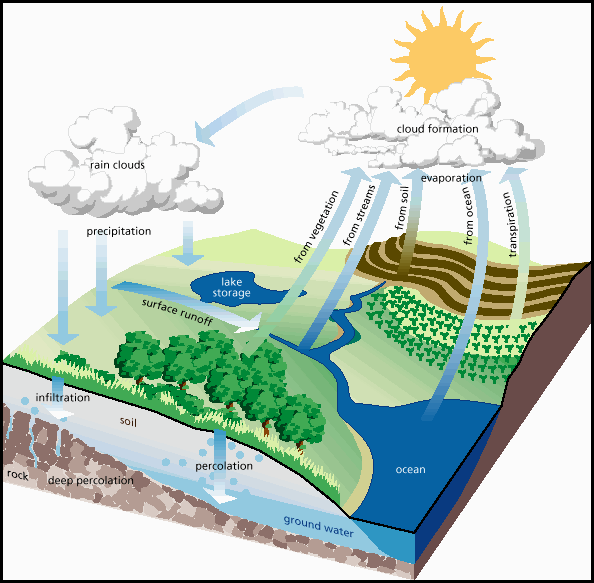
Thursday, we were at the Kerr Wildlife Management Area where we learned all about the water cycle and how vegetative cover on rangeland impacts everything from evapotranspiration to infiltration rates. We rained on plots, measured soil temps, infiltration, aggregate stability and watched various brush species waste water right before our very eyes. We swam in the spring fed Johnson Creek (awesomely beautiful) and worked on our notebooks which were due that evening. We finished off the day with snacks and a quiz bowl competition that ran past midnight!

Friday morning we did ranch plans, compiling all the knowledge we gained throughout the week. We presented our plans and gathered our things to return home. Closing ceremonies Friday afternoon included recognition for the cleanest cabin, leaders in our cabin groups, champion recreational group, best plant collections and notebooks, the Sam Coleman Award for combined notebook and plant collection achievement and the coveted Trail Boss award.

Woven throughout the week was the concept of stewardship. Directors presented the origins of the word stewardship and the biblical reasons we are called to learn to care for the land and the animals.

Plans are already underway for the 2012 Youth Range Workshop!

Have you attended or helped organize a range camp? What was your experience like?

Wednesday, June 29, 2011

Ethnobotany: An interesting perspective on range management, at a bombing range.

By: J. Johansen, SRM Student Member

Ethnobotany: the study of how a culture uses plants. But, who cares about plants anyway? Let alone knows their names, their relationships to each other and other living things? Aren’t all those cultures dead? I find it interesting that the American sub-culture of the range manager may be one of the few who still speak the language of plants.

Range Manager, or Plant Magician?
 On this year’s Pacific Northwest Summer Tour we got a real treat, a trip through the Yakima Training Center, the US Army’s live-fire training grounds. Our gracious host shared with us his job of keeping the soil on the ground, in spite of tanks, artillery, and fires. He guided us through test plots of grasses and shrubs planted in the late 90’s, describing how each had faired over time, and how well they stood up to the abuse of army vehicles driving over them. The test plots were really interesting, in that it could be seen what plants had failed completely, what plants wandered out of their row, what plants grew larger at the edge of their plot to try and outcompete it’s neighbor, and just the chance to work on identification. The YTC’s Botanist consultant set me strait that the “two” grasses I had were in fact the same, one just had a fungal infection (don’t worry, cheatgrass!). Also, in another area towards the end of our YTC tour, we looked at a test plot from 1961.


SRMer's speak the language of plants
Land destroyed by wildfire!

In this area we looked at the after effects of a wildfire and sage seedlings that had been planted last fall. The grasses and massive amounts of lupines in this photo and all throughout the burn area had come back on there own, without seeding. The sage seedlings were planted because a large portion of the burn was within a Sage Grouse protection area (yes, on a bombing range) and they wanted the sagebrush to return.

Intact sagebrush system with previously burned hill behind

We also visited sites outside the YTC grazed by the Martinez family’s bands of sheep. One of the Principals of the largest sheep operation in the state of Washington, Mark Martinez was generous to take time out of his day, show us several sites and discus the ins and outs of running seven bands of about 7,500 sheep total.

*** J. Johansen will be attending OSU’s Range program at Eastern Oregon University for his junior year this fall, is working as a NRCS student intern, and has no credibility whatsoever. You can take a peek at what he does in his spare time at http://www.rideherd.com.

Thursday, June 16, 2011

Interest Piece: Native American uses and management of California's grasslands

By Maggie Haseman, SRM Outreach Intern

I recently read an absorbing chapter by M. Kat Anderson titled, “Native American uses and management of California’s grasslands” in the book California Grassland: Ecology and Management (2007). I am intrigued by the many ways humans have historically used plants and thought this chapter about California grasslands was a good example and a note-worthy read.

Native tribes had many uses for the plants found in California’s grasslands. The California area is unique due to its Mediterranean climate; because of this many plants in the region are endemic. Anderson’s chapter outlines how California grassland plants were used for clothing, basketry, construction materials, cordage, medicine and food.

I found it interesting to read about the various clothing and adornments the natives created from plants. For festivals, dances and ceremonies, tribes such as the Tongva and Yokut often wove wildflowers, such as cluster-lilies (Brodiaea), triplet lilies (Triteleia), dicks (Dichelostemma), iris (Iris douglasiana), and common monkeyflower (Mimulus guttatus), into their hair, and to wear in wreaths, crowns and boas. The Sierra Miwok used sleepy catchfly (Silene antirrhina) for dying face paints and wore the flowers of the non-native quaking grass (Briza humilis) in pierced-ears. The Chukchansi Yokut used an unidentified grass they called chulochul to make the front side of women’s skirts and the Wintu made regalia out of grass mat, willow (Salix) sticks, flowers and feathers.


Photo from:
Eastern California Museum
 I was particularly interested in the section regarding the arts of basketry and cordage, or rope making, both of which are old crafts dating to 10,000 years ago in western North America. Anderson outlines how plants such as alkali sacaton (Sporobolus airoides),which was widespread throughout the region, bracken fern (Pteridium aquilinum), which was prized for the black rhizomes, and deergrass (Muhlenbergia rigens), which swells in water helping to make baskets water tight were all once used to make baskets. The chapter lists some popular choices for cordage included: throughout California, dogbane (Apocynum cannabinum); in central California the milkweeds (Asclepias); in the northeastern part of the states irises (Iris); and in the southern deserts yucca (Yucca) and agave (Agave).

Also interesting was the use of plants, especially grasses, in the construction of structures and furniture. The Yana, Wappo, Owens Valley and Mono Lake Paiute, Cahuilla, Salinan, Pomo, Modoc, Klamath and Chumash thatched various structures with grasses such as giant wildrye (Leymus condensatus) and California fescue (Festuca californica) Anderson tells us the Pomo created beds by digging a hole, filling the hole with dry grass and covering the grass with tule, mats and/or skin blankets. She also notes that the Michahai and Chukaimina Yokut snake doctors made cages to carry rattlesnakes in, of an unidentified twined stiff grass.

The subject I found most fascinating were the extensive practices cited by the author for medicinal needs. The use of plants for medicine was widespread throughout California tribes. The Kumeyaay made tea for cramps from the leaves of sanicle (Sanicula arguta), the new shoots of giant wildrye were made into a tea by the Chumash to treat venereal disease, the Pomo induced sleep using dried and powdered red larkspur (Delphinium nudicaule), and the Coast Miwok made the roots of the blue-eyed-grass (Sisyrinchium bellum) into a tea to heal stomachaches. Anderson highlights the common yarrow (Achillea millefolium) as the most versatile medicinal plants used by the Ohlone, Yokeya Pomo, Washoe, Hupa, Karuk, Yurok, and Tolowa for teas, decoctions, powders, infusions, and cool or warm presses. The common yarrow was used for washing sores, alleviating toothaches, stomachaches, and headaches, treating burns, chills, fever, and sore eyes, and preventing swelling, and colds.

Perhaps the most prominent use of plants in California was for food; Anderson cited that 60-70% of nourishment for Californian tribes was derived from plants; not including the use of plants for seasoning such as the use of salt crystals from salt grass (Distichlis spicata). Grains, from grasses such as California brome (Bromus carinatus), Indian ricegrass (Achnatherum hymenoides), and the wildryes (Elymus) and seeds from wilflowers including mules-ears (Wyethia), clarkias (Clarkia), buttercups (Ranunculus), and popcorn flower (Plagiobothrys nothofulvus) were a good source of protein. The Yokut used acorns (Quercus) as an additional source of protein. For carbohydrates, California tribes searched underground for bulbs, corms and tubers. The Pomo ate the roots of cutleaf silverpuffs (Microseris lacinata) raw with nut bread. Corms from, cluster lilies, triplet lilies and dicks, and tubers from, yampah (Perideridia), turkey pea (Sanicula tuberose), soaproot (Chlorogalum pomeridianum), and mariposa lilies (Calochortus) were eaten raw, boiled, steamed, baked or roasted. For vitamins, minerals and fibers, Anderson outlines how California tribes harvested leafy greens to eat raw, soaked, or boiled, such as clovers (Trifolium), lupines (Lupinus), and fiddlenecks (Amsinckia). The Mountain Maidu collected woolen beech (Hydrophyllum capitatum) leaves, the Ohlone harvested sun cup (Camissonia ovata) foliage; the Atsugewi gathered wild parsley (Ligusticum grayi); the Kawaiisu picked common lomatium (Lomatium utriculatum). Also popular were angelicas (Angelica), which were used as seasoning in soups, and docks (Rumex), which are higher in vitamin C than citrus juice and higher in vitamin A than carrots.

According to Anderson tribes found extensive uses for the wildflowers, grasses, sedges and ferns native to California; the plants succored, fed, sheltered, and clothed the Native Americans for thousands of years. This article was very informative about the uses of plants native to California, I personally can’t wait to get out there and test some of these ancient customs. For more information or to read this chapter in its entirety, here is the citation:

Anderson, M.K. (2007). Native American uses and management of California’s grasslands. In M.R. Stromberg, J.D. Corbin & C. D’Antonio (Eds.), California grasslands: ecology and management. (pp. 57-69) Berkley, CA: University of California Press

Friday, June 3, 2011

SRM Welcomes Maggie Haseman, SRM Summer Outreach Intern

Maggie Haseman, tired after a long hike to our campsite on a father-daughter backpacking trip to Crater Lake in July 2010
Hi SRM, my name is Maggie Haseman and I am the new Outreach Intern here at the SRM office in Wheatridge, Colorado.  I will be a senior at Colorado State University in the fall.  I am working toward a Bachelor of Science Degree in rangeland ecology with a concentration in restoration ecology and a minor in global environmental sustainability.  After I graduate, I want to get a Master’s Degree in ethnobotany, the study of the relationship between plants and humans.  Eventually I would also like to go to law school and study environmental law.

I have lived in colorful Colorado all my life and am currently living in Fort Collins, CO.  I enjoy many activities such as hiking in the beautiful Rocky Mountains and playing the ukulele.  I also play tennis, when I get the chance, and spend time playing cards or board games, and chatting with my friends and family.

I am a first-year SRM member and heartily enjoyed attending the SRM Annual Meeting in Billings last February, where I competed in the plant ID competition.  I am very happy to have the chance to get more involved in the society through this summer Internship Program.  You will hear from me often on the SRM Outreach Blog, Facebook page and LinkedIn group until August when I must go back to school.

As the Outreach Intern I have been working on various projects for SRM including helping with the details for the 2012 Annual Meeting in Spokane, Washington, and organizing a meeting contact list so that the Society can be more efficient and organized about contacting parites for news and events related to the Annual Meeting.  I plan on using my experience at SRM and my interests in both rangelands and ethnobotany to write a series of blog posts on the history of the American Great Plains.  I would like to look into the ways that humans have shaped the ranges and also how the ranges have shaped us.

Friday, May 6, 2011

International Rangeland Congress and Tours, Argentina

Guest Post by Joe Wagner, PNW Section of SRM


South Patagonia PreCongress Tour

El Calafate Moreno Glacier

The Pre-Congress Technical Tour started in El Calafate (State of Santa Cruz), where we spent two days.  El Calafate is located on the largest lake in Argentina.  This is a glacial lake and the Moreno Glacier is at the head of the lake.  The Moreno Glacier face is 300 feet high and it was calving at the late summer date we visited.  This glacier is part of the third largest ice field in the world – only behind Antartica & Greenland.

The 1st thing I noticed riding in from the airport was a roadside fence line contrast.  There was a lot of what I thought was a grey shrub and very little in the surrounding pastures.  This area was heavily sheeped in the past.  Checked with the tour guide and found out what I thought was a shrub was a large bushy Senecio.  The two main grasses were Fescue and Stipa.

Third Day we traveled by bus to Rio Gallegos to catch a flight to Tierra del Fuego area.  We visited an area at the east end of Lake Argentino, where grazing/wood cutting exposed the silty/sandy glacial soils to wind erosion.  They planted Elymus and shrubs to hold the soils in place.  It is still grazed to some extent.  We also observed heavy grazing and light grazing on a riparian/wetland areas (mallines = meadows where water is near the surface).  We visited a sheep Experimental area, where they were testing different grazing systems.  I learned about ground shrubs that the sheep use.  I casually looked at the plant they were talking about and initially thought it was a healthy cryptogam, however it did have a woody stem to it.  Inside the exclosure it was about 5/6 inches high after 5 years of rest.

Ushuaia Tierra del Fuego

We landed in Ushuaia that calls itself “City at the end of the world”, approximately 69 degrees south.  Of the Equator.  City is located on the Beagle Channel, where Charles Darwin spent time.  Historically, the Native Americans did not wear clothes; only seal skin capes (brrr!!).  The women were responsible for collecting mollusks.  They smeared seal fat on their bodies to insulate against the frigid waters.  The biggest resource problem I saw in Tierra del Fuego Park involved beaver.  They were introduced in 1943 to enhance the fur trade.  The fur trade fizzled and now they are running wild with no natural predators.  They are doing a job on standing trees as well as flooding out trees in the bottom lands.  Great Sea food in Ushuaia.

Rosario International Rangeland Congress

Rosario is a city of under one million people, in the State of Santa Fe.  It is a very clean city.  There are several stray dogs per block that laze about and help keep the food items out of the gutters.  The dogs don’t belong to anybody, but are fed, watered and tolerated by folks.  The only time I saw folks harass the dogs was when shop keepers shooed them out of the entrance to stores, when they flopped down.  It was amazing to see so many nice condition Ford Falcons from the 1960s driving around.  The Parana River flows through Rosario and fish dinners were great.

The IRC had about 500 people in attendance from 40 to 50 countries.  There were close to 700 papers/posters, 3 pre-congress tours and 3 mid-congress tours.  Proceedings will soon be available on the IRC website at http://www.rangelandcongress.com/ and available at catrina.batello@fao.org at no cost.  The next Congress will be in India in 2015.  I went on the Parana River Island mid-congress tour.  The river was in a low flood stage and most of the cattle had already been ferried across the river to areas west of Rosario.  However, it was interesting to see cows and calves swimming and some cows swimming and grazing at the same time.  I asked about caimans bothering the cattle (local ones are smaller than those in Amazon Basin) – wild pigs are more of a threat to calves.  The ranchers burn their lands by themselves every Fall, so they can find the cattle as the vegetation gets pretty thick and high otherwise.  The Poster I found the most interesting was from Israel, using goats to create fire breaks around forested areas.  I asked about the bad fire in their forest last summer and he said the crown fire dropped to the ground when it hit the goat grazed area. 


Iguazu Waterfalls Bariloche.

I made two trips after the congress.  Iguazu Waterfalls (state of Misiones) are way up north on the Brazil Argentina border.  One of the falls is horse shoe shaped at the head of a large canyon called the “Devils Throat.”  There are several falls on the Brazilian side and a long series of falls on the Argentina side.  This waterfall was as spectacular as Niagra Falls and Victoria Falls and the geology of the long canyon and rim made this a huge area.

The next trip was to Bariloche (State of Rio Negro) about midway in the country, but on the west side near the Andes mountain range.  The area was settled by Swiss and German pioneers. The architecture with the Andes backdrop made one feel that they might have been in the Alps.  Cathederal Hill is probably the only major ski area in South America.  The rainfall in Bariloche was 1,000 millimeters near the mountains and going 35 km east and it drops to 500 mm and continues drop to about 250 mm as you go east until the Atlantic Ocean influence raises the rainfall.  I was able to visit the San Ramon Estancia (Ranch) in the 500 mm zone and there were many conifers growing, all introduced from Europe, Australia and North America.  The Ranch produced cattle that grazed the meadows and sheep that grazed the upland steppe.  The ranch was 250,000 hectares in size.  The entire ranch and buildings were burned in a wildfire in 1996 and the manager said vegetation was still recovering in certain areas.  I thought I was standing in grass in a rest pasture, but was I wrong.  It was a Stipa that came half way up my calf and neither cattle nor sheep will graze it.  The trees that they were selectively logging had ½ to ¾ inch growth rings present from about 40 year old trees.  The introduced Red Deer grow some tremendous racks 2 ½ to3 feet wide with 16 points on some.
Beautiful, unpalatable stipa
 Argentina has the highest per capita meat consumption in the world – 75 kg/person.  We ate well and a high protein diet it was great!!

Friday, March 18, 2011

Rangelands are Adorable

By Aleta Rudeen, Director of Outreach and Leadership Development for SRM

Source: cute-kittens.com

So... unfortunately rangelands aren't really adorable.  But they do need your help.

I am writing from a conference with lots of non-profit organizations that have sexy causes -- they have messages that the general public understands in a sentence or less and issues that are easy to get on board with, without necessitating any background to get people jazzed.  SRM doesn't have that advantage; turns out it's difficult to evoke the right emotions by flashing a specimen of bouteloua gracilis or a well-designed state-and-transition model.  But that doesn't lessen the importance of rangelands, it just means we have more ground to cover when reaching out to the public on the issues that are important to rangeland ecosystems and SRM professionals.

As members of SRM we are a community that is passionate and knowledgeable about rangelands, but we need to get creative about communicating that message.  Rangelands are important, and they do matter.  But how do we get the public to care?

I am in the process of compiling some outreach materials for SRM - think brochures for youth to start, but we will expand from there as projects develop.  I am looking for the feedback and expertise from the experts: you.  What would you tell the world about rangelands and about SRM?  How do we write about the mission and importance of the Society in a few sentences or less?  How can we put years worth of research and learning into a few short bullet points?

Please send me your ideas, your thoughts, and your content!  You can email me at arudeen@rangelands.org, post ideas to Facebook, or respond to this blog post.  Help us develop our materials and get the message out there.  ...Because while rangelands aren't cuddly-pinch its cheeks-cute, they are massively important ecosystems and their sustainable management will affect generations to come.

Tuesday, January 11, 2011

SRM Spotlight Synopsis: Final Report by SRM Outreach Intern, Julia Workman

Serving as Society for Range Management’s first Outreach Intern this semester has been an amazing learning experience. My first goal for the Internship was to glean personal insight from SRM members and make this information available through posts on the SRM blog. My duties taught me to present information in a manner that would appeal to a wide audience, with varied backgrounds but a common interest. Along with this, I had the opportunity to travel to Grand Junction for the Colorado Section fall meeting, and to share what I have learned in the interviewing process. My second goal was to establish relationships and gain experience interacting with the diverse group of professionals involved in SRM. This was achieved through communication with the members I interviewed and various other members with whom I interacted. My time at the Colorado Section meeting allowed me to meet with with experienced members on a personal level while carrying out my internship duties. The insights gained from these experiences will be valuable as I go forth and attempt to achieve my own career ambitions.

To gather the information from SRM members, I conducted ten interviews with members representing eleven different sections (Pacific Northwest, California-Pacific, Idaho, International Mountain, Wyoming, Colorado, New Mexico, Northern Great Plains, South Dakota, Texas, and Florida). Nine of these interviews were conducted by telephone, and the remaining interview in person at the Idaho Section fall meeting. Interviewees represented a broad range of professions in the field of rangeland management: two ranchers, three researchers (including one professor emeritus), three government agency-employed resource managers (two with the federal government and one with a state), one private contractor, and one botanist. Most came from rural backgrounds related to rangelands or agriculture, but each had followed a unique career path, and all had played very different roles in SRM. Despite the diversity of individuals I interviewed, there was an overall trend of similar answers and common themes throughout the interviews.

One of the first questions I asked each member was why he or she had joined SRM. Three joined in college, and seven during their professional careers. Their reasons for joining included the information offered, the professional development opportunities, employer or agency encouragement, or a combination of the three. They were then asked, based on their experiences, what SRM can do to attract and retain members. Their answer: Stay relevant! Be more engaged with the public, and more visible. Make apparent exactly what SRM is doing in rangeland management. Another suggestion was that the Society needs to attract students, then keep track of them as they move into the workforce by maintaining personal contact. Attracting individuals at the local level and through agencies is also going to play a big role—again, through personal contact. Another important aspect, which was emphasized again and again by member after member, is outreach. Rangeland management is broadening in its scope, and the spectrum of people the Society is trying to reach should broaden as a reflection of that.

One focus of my interviews was on the changes that are occurring in SRM and the workforce. The members with whom I spoke said that the main principles of SRM have remained the same, which is very important to them. But they also talked about some positive changes, like increased involvement from younger generations and the large student presence in the Society right now. It was great to hear these longtime members talking about how the younger generation is bringing new ideas and a new energy to the profession! From a logistical standpoint, interviewees felt that it is also really important that younger members be able to fill the gaps in the workforce left by retiring members, especially the members of the “Baby Boomer” generation.

Another important theme mentioned with respect to SRM’s recent changes was the way the Society is reaching out to other groups. One example cited was the producer forums which were held at the Annual Meeting in Denver last year. Two interviewees felt that SRM has distanced itself from livestock production groups in the last several years and are really pleased with the reverse in that trend. Another long-term member was pleased with the way the Society is embracing ecology. He pointed to the journal change to Rangeland Ecology and Management as evidence of that; another great example of the Society’s emphasis on ecology is the Ecological Site Description workshops with which SRM is currently involved. This means the Society is reaching out in a lot of different directions and satisfying people with very different interests. One of the most important groups to reach out to is the general public. Rangeland managers are increasingly seeing the need to be aware of society’s opinions and deal with them. As management for broader interests, like open space, becomes more prevalent, it is becoming increasingly important to embrace nontraditional areas like policy and human dimensions—because these aspects are now intrinsically intertwined with rangeland management.

Another big change in SRM is an increased emphasis on using technology, both old and new. The Internet, for example, can be a major tool in facilitating everything from communication to research. Information can be found with an ease never possible before, through resources ranging from online journals to programs like Google Earth that offer a big view and great resolution. As we manage on a broader scale, it is important to let land managers see their parcel in the context of the bigger landscape.

I also asked interviewees what SRM can do to better serve its members. One important service, they said, involves continuing to provide lines of communication between agencies, landowners, land managers, and environmental groups, while providing a safe venue for discussion between said groups.

It is also very important right now, as many members are retiring and many others joining the workforce for the first time, that knowledge be passed between generations. It is therefore going to be critical to retain members after they retire in order to retain that institutional knowledge for the sake of the profession. One of the most important places for mentoring to occur between generations is at local field days and tours, where the younger members can get their hands dirty and gain real field experience, in a one-on-one scenario. However, Annual Meeting mixers also play an important role in opening channels of communication and fostering relationships.

What these members value about SRM (what it is doing well) was another question posed in these interviews. A few mentioned the journals and continuing education, but every single interviewee emphasized the networking and personal connections they have gained through SRM, and how valuable and irreplaceable those have been.

As for where the Society is headed, half of the members interviewed said that down the road, they want SRM to still be alive. These members want to see the Society still active, relevant, and viable—“continuing to do what we do, respectably.” They would like to see SRM continue to be a voice for rangeland management and for rangelands themselves: it is unique among professional societies in that it speaks for the resource. They said SRM needs to be looking at broader issues as the profession broadens. It needs to continue to diversify its membership, while maintaining its founding ideals. These members want to see the dissimilar groups involved in rangeland management working together toward common goals, because in diversity there is strength.

The overall consensus through these interviews was that the Society is doing very well. All the people with whom I spoke were positive about where SRM is now and where it is headed—at least, in the words of one, “there’s always room for improvement, but it’s not necessarily a poor job.”

As for me, through this experience I gained a much better appreciation for some of the history of SRM and some of the changes the Society has seen in the past few years. It was fascinating to get to know members who have played huge roles in their respective sections and states, within and outside of SRM. The different perspectives these members have, the changes they have seen, and the directions we are taking, say a lot about where we stand as a Society. I find it reassuring that they were for the most part pleased with where we stand. However, it was educational to hear about some of the issues SRM has been facing. New members like me sometimes do not always hear a balanced report involving the negative aspects of a group or the difficulties it is facing.

I believe that I have personally grown in this experience by overcoming a great deal of shyness in talking to strangers over the telephone. By having to do so, on a weekly basis, I have become much more comfortable with introducing myself and conducting business in a professional but relaxed manner. Correspondingly, this development has also helped me in dealing with people face-to-face. It was more natural for me to strike up conversations with total strangers at the Colorado Section meeting, and to ask questions. This is a professional skill that many of the individuals interviewed told me will be important in my career, and I believe that this Internship has been very influential in helping me develop it.

Written communication has also been an important part of this experience. It was my primary means of interaction with others during the Internship, and this required a honing of my writing skills to develop the proper tone in correspondence via email, and in posting of blog updates. The blogging necessitated that I learn to transcribe what members said over the phone into informative and interesting posts that would not offend, mislead, or misrepresent. Representing a professional Society in such a fashion, I learned to pay close attention to the tone and message presented by each phrase and comment to avoid misrepresentation of the individuals and the organization. It was a valuable experience and allowed for a better understanding of the “politics” that such a position means.

Overall, I have had a wonderful semester and would like to thank SRM and its members for the opportunity to take part in this Internship. I believe that the Internship is a great opportunity and hope to see more involvement from both students and members as the program continues to grow.