Showing posts with label plant identification. Show all posts

Friday, July 8, 2011

Texas Section Youth Range Workshop - 2011

By Jenny Pluhar, Texas Section
The Texas Section just completed our 57th Annual Youth Range Workshop. That’s right…57 years. We had 28 youth and 14 directors. We had six days of fun in the sun. Even had some rain, which is as rare as hen’s teeth in Texas this year!
We began on Sunday afternoon learning about the importance of rangelands. Texas is roughly 60% rangelands that serve as watersheds for some of our largest urban areas, so rangelands here are important to everyone from the city folks to the ranchers, hunters and recreationists. Monday we began plant collections and learned to use GPS on the range. We also began our public speaking exercises. Days began early (thought for the day was at 7 am) and we worked through til 11 pm each night. It doesn’t take long to spend the night at Youth Range Workshop in Texas!

Tuesday, we toured the Landers Ranch, ran pace transects, clipped plots, measured brush density, read photo plots and learned the fine points of utilization, stocking rates and range economics. We were especially honored to learn from Dr. Jake Landers, who attended the very first TSSRM Youth Range Workshop. More recreation, public speaking, and classroom analysis of the data we collected.

Wednesday, we toured two ranches, watched demonstrations of mechanical and chemical brush control, learned about prescribed fire (usually we do a burn, but it is too darn dry!), conducted endangered species surveys, even watched a Texas horned lizard eat harvester ants and burrow into the soil. More plant collecting, recreation, and public speaking.

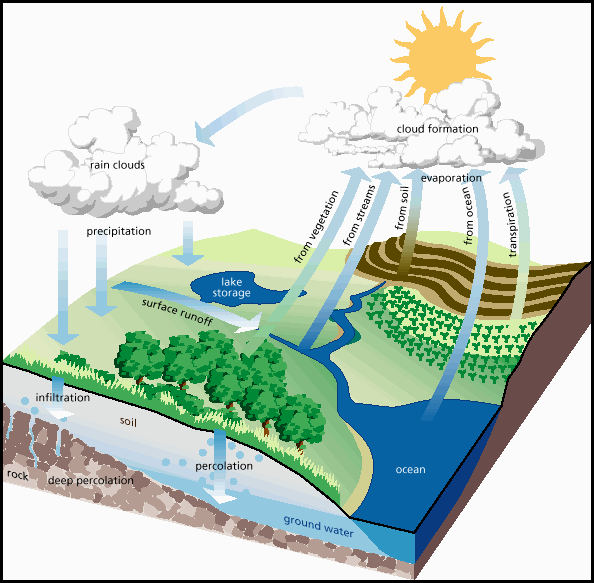
Thursday, we were at the Kerr Wildlife Management Area where we learned all about the water cycle and how vegetative cover on rangeland impacts everything from evapotranspiration to infiltration rates. We rained on plots, measured soil temps, infiltration, aggregate stability and watched various brush species waste water right before our very eyes. We swam in the spring fed Johnson Creek (awesomely beautiful) and worked on our notebooks which were due that evening. We finished off the day with snacks and a quiz bowl competition that ran past midnight!

Friday morning we did ranch plans, compiling all the knowledge we gained throughout the week. We presented our plans and gathered our things to return home. Closing ceremonies Friday afternoon included recognition for the cleanest cabin, leaders in our cabin groups, champion recreational group, best plant collections and notebooks, the Sam Coleman Award for combined notebook and plant collection achievement and the coveted Trail Boss award.

Woven throughout the week was the concept of stewardship. Directors presented the origins of the word stewardship and the biblical reasons we are called to learn to care for the land and the animals.

Plans are already underway for the 2012 Youth Range Workshop!

Have you attended or helped organize a range camp? What was your experience like?

Wednesday, July 6, 2011

High Desert Youth Range Camp Celebrates 1st Successful Year!

By Brenda Smith, Pacific Northwest Section


Group Photo

An extraordinary tradition that has been dormant for many years was renewed when 16 high-school age students from across Oregon and Idaho gathered June 19th-23rd for the first annual High Desert Youth Range Camp at the Northern Great Basin Experimental Range (NGBER) 40 miles west of Burns, OR. Well over a year ago a range camp committee made up of ARS scientists, Oregon State Cooperative Extension specialists, Treasure Valley Community College instructors and Harney County school district science teachers organized to develop the curriculum and logistics to host the camp at the 16,000 acre rangeland owned by the USDA-ARS. All told volunteers from nine agencies and local ranches committed their expertise and time as camp counselors, instructors, cooks to direct activities for the 4 day camp. The camp staff and presenters were all absolutely outstanding and put a tremendous amount of work and sacrifice to make range camp in Oregon a reality. The Pacific Northwest Section of SRM board of directors was instrumental in supporting the camp and provided a substantial financial donation to see range camp get off to a good start. A number of conservation districts and even private ranchers supported scholarships for students to attend.

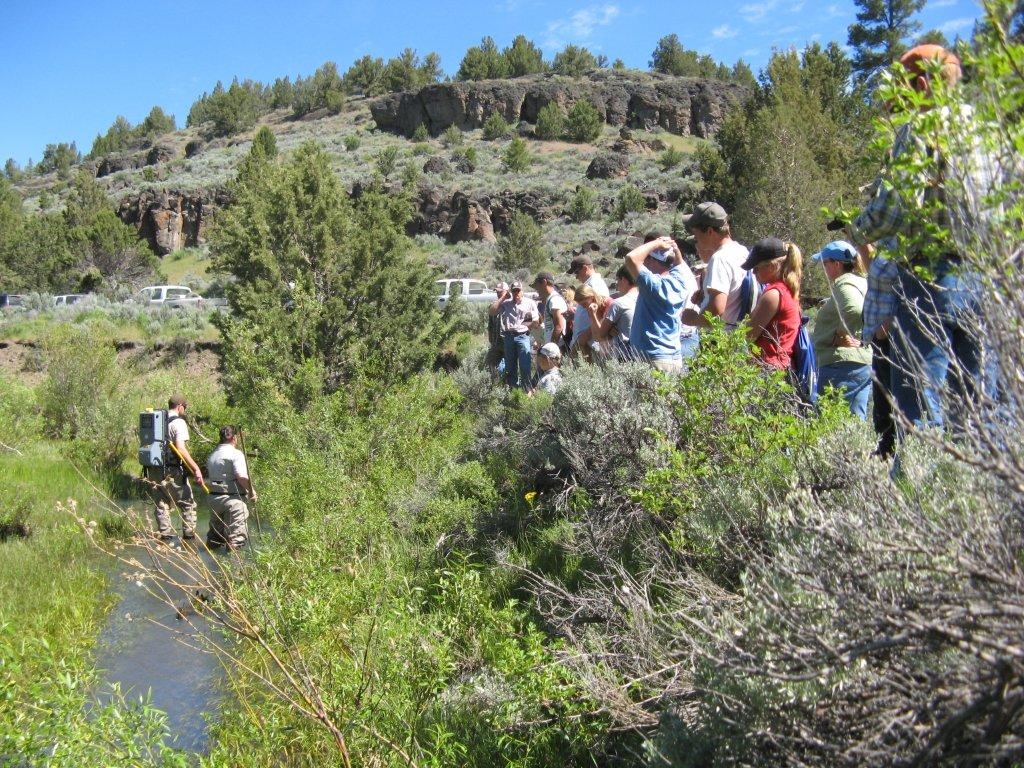
Riparian Studies
Top of the World (or a Butte)

Activities included map reading, GPS, compass and orienteering, soils investigation activities, plant identification and monitoring, interactions of fire, grazing and weeds, Juniper woodland investigations, wildlife presentations on mule deer and sage grouse, a visit to the nearby Hotchkiss Co. Ranch, riparian zone investigations, student team presentations, daily team building and leadership activities, and more. The students in attendance were interested, engaged, and adventurous and worked extremely well together. It was a downright “fun” learning experience. The top student selected to attend the SRM High School youth forum is Isaac Studtmann from Long Creek, OR. Just a few of the comments received from the students include “I feel that I have taken so much out of this camp and could see myself working in this field”, “I feel so much more informed about issues with rangeland management. I am now considering a career in rangeland management much more now!” and “Overall I think camp went very well and I am happy I came. Thanks for doing this for us.”

Soil tests
We all are very excited to have a range camp back in Oregon and look forward to keeping the renewed tradition going and growing.

Thursday, March 24, 2011

Range Camp Rocks

Spring is finally upon us.  For students, the melting of winter signifies that it is time to start thinking about summer break and how you will spend your time.  What could you possibly do to maximize both fun and professional development simultaneously?  For those high school students interested in rangelands, the answer is easy: attend range camp.  Visit your local SRM section website and contact the officers to find out what opportunities are in your area.  Below is an article by Terilyn Chen outlining exactly why Range Camp Rocks.

Range Camp Rocks
September 11, 2010 Posted in: Opinion
By: Terilyn Chen


This summer I vaccinated a sheep. With help, of course.

I learned to do that, among other things, at the 26th annual California-Pacific Range and Natural Resources Camp. I attended camp from June 20 to June 25 with Hercules High School senior Nicole Ng, and other students from all over California. Founded by Mike Stroud in 1985, Cal-Pac Range Camp is an annual environmental science camp held on the beautiful Elkus Ranch in Half Moon Bay.

Ng and I were among the few campers who had absolutely no experience working with livestock and ranches. Herculean culture is entirely different; I doubt many people know what FFA is and we do not have a farm. I am embarrassed to admit, but before camp, I thought everything related to hardcore agriculture and livestock was for Texans and Montanans. Somewhere in my head, I obviously knew California is a big farming state, but I just never thought there would be a camp that taught about livestock so close to home. Needless to say, the experience was an eye-opener.

At camp, we were constantly busy. Never in my life had I felt so accomplished when the day was over as I did during those four days. Every single minute was well spent, whether I was learning how to tell the difference between yarrow and poison hemlock, searching for fly larvae underneath the rocks in Purisima creek or talking about boys with a couple of buddies while walking across camp to take a shower. We even spent half a day in bright yellow hard hats, walking around Purisima Creek Redwood Forest with a forester who showed us how he decides what trees to cut, and why.

By the end of the first day, I was falling in love with range camp and everything I never knew California possessed.

The world that had previously seemed to me full of ubiquitous settling and compromising had something tangible to offer me: real examples of people simply unable to contain their passion.

The camp coordinator Marc Horney, the botanists, soil scientists, fire ecologists, entomology connoisseurs- every single one of our instructors and advisors were obviously in love with what they did. Their bubbling excitement was intoxicating, as was the magical environment they had chosen to use as their classrooms, because really, velvet grass makes such an impression.

I felt so complete when the sun was disappearing behind the hills. Several times, I wanted to cry because camp made it seem like there was a reason for everything. Since then, I have believed in the goodness of people again. Or rather, I believe in my own strength; it was as if camp made me realize that I can make a difference. Suddenly, beating global warming and climate change seemed possible.  After all, there were people out there running camps about environmental science.

The night before our last day at camp, I knew that I would soon mentally go over every memory and physically touch every plant I could get my hands on, in a crude attempt to hold on to Range Camp.  The next day, when I actually left Elkus Ranch, and my family drove away with me on the freeway, I felt traumatized, as if my senses were not yet adjusted to the loudness, the hardness and the greyness of the world. For the next few days, I felt lost in suburbia. I was lost in the uniformity and the cleanliness.  Over the course of the summer, I would dream about Range Camp for a total of seven times.

Later, walking around Hercules, I actually found flowers and grasses that I could identify. I realized that there is no reason to be sad because I had taken so much from Range Camp. So thank you, Kent Reeves and the Yolo County Resource Conservation District for sponsoring me, and thank you both Michael Hudson and Nicole Ng for introducing me to Range Camp.

Range Camp has enlightened me. It has changed me. It has permanently made me a “happy camper.”

Monday, June 14, 2010

Nebraska Youth Range Camp


Early last week I attended part of the Nebraska Youth Range Camp, near Halsey, Nebraska.  The camp had 41 high school students in attendance from around the state.  During the week-long camp, students gain experience and training in rangeland ecology and management through a variety of presentations and lesson plans.  Time is spent both outside and in, as students learn about topics ranging from plant identification, range sites, ecology, and condition, grazing strategies, tips for going to college, and conflict management.  Two take home messages from Monday evening and Tuesday morning were 1) there is much more to rangeland ecosystems than just cows, and 2) get involved!


The Nebraska Youth Range Camp is operating in its 47th year and has trained more than 1,500 students since its inception in 1963.  While all students in attendance had some interest in rangelands, many were unsure how they would apply that interest as they went off to college and on to their careers.  Instructors highlighted the utility of mentors and students were encouraged to get in touch with other professionals (SRM members included) to use as resources for college and beyond.


While visiting the camp, I had the exciting opportunity to experience my first ever tornado warning, when the warning alarm went off shortly after bedtime.  Everyone at camp: all 41 high school students, a group of 4-H campers, and all instructors, crammed into the basement/bomb shelter of one small building to wait out the watch.  I was glad I had my camera on hand to capture some stylish students during the hour plus spent in the basement.  My personal favorite: several folks sporting a pj's and cowboy boots combo.
Thank you to the Nebraska Youth Range Camp for their hospitality!  Stay tuned - I am heading to the Pacific Northwest section meeting in Kelowna, B.C. this week.