Showing posts with label Texas Section. Show all posts

Friday, July 8, 2011

Texas Section Youth Range Workshop - 2011

By Jenny Pluhar, Texas Section
The Texas Section just completed our 57th Annual Youth Range Workshop. That’s right…57 years. We had 28 youth and 14 directors. We had six days of fun in the sun. Even had some rain, which is as rare as hen’s teeth in Texas this year!
We began on Sunday afternoon learning about the importance of rangelands. Texas is roughly 60% rangelands that serve as watersheds for some of our largest urban areas, so rangelands here are important to everyone from the city folks to the ranchers, hunters and recreationists. Monday we began plant collections and learned to use GPS on the range. We also began our public speaking exercises. Days began early (thought for the day was at 7 am) and we worked through til 11 pm each night. It doesn’t take long to spend the night at Youth Range Workshop in Texas!

Tuesday, we toured the Landers Ranch, ran pace transects, clipped plots, measured brush density, read photo plots and learned the fine points of utilization, stocking rates and range economics. We were especially honored to learn from Dr. Jake Landers, who attended the very first TSSRM Youth Range Workshop. More recreation, public speaking, and classroom analysis of the data we collected.

Wednesday, we toured two ranches, watched demonstrations of mechanical and chemical brush control, learned about prescribed fire (usually we do a burn, but it is too darn dry!), conducted endangered species surveys, even watched a Texas horned lizard eat harvester ants and burrow into the soil. More plant collecting, recreation, and public speaking.

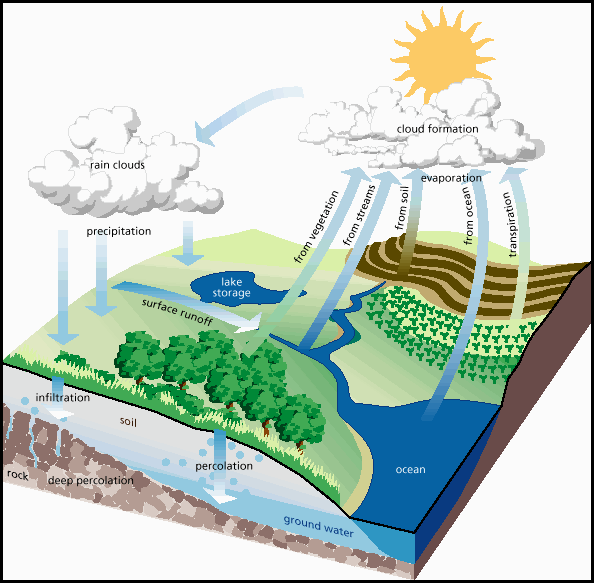
Thursday, we were at the Kerr Wildlife Management Area where we learned all about the water cycle and how vegetative cover on rangeland impacts everything from evapotranspiration to infiltration rates. We rained on plots, measured soil temps, infiltration, aggregate stability and watched various brush species waste water right before our very eyes. We swam in the spring fed Johnson Creek (awesomely beautiful) and worked on our notebooks which were due that evening. We finished off the day with snacks and a quiz bowl competition that ran past midnight!

Friday morning we did ranch plans, compiling all the knowledge we gained throughout the week. We presented our plans and gathered our things to return home. Closing ceremonies Friday afternoon included recognition for the cleanest cabin, leaders in our cabin groups, champion recreational group, best plant collections and notebooks, the Sam Coleman Award for combined notebook and plant collection achievement and the coveted Trail Boss award.

Woven throughout the week was the concept of stewardship. Directors presented the origins of the word stewardship and the biblical reasons we are called to learn to care for the land and the animals.

Plans are already underway for the 2012 Youth Range Workshop!

Have you attended or helped organize a range camp? What was your experience like?

Friday, December 3, 2010

SRM Spotlight: Matt Wagner, Texas Section

By Julia Workman, SRM Outreach Intern
“Don’t be afraid to go in a direction that’s outside your comfort zone, your area of expertise,” says Matt Wagner, Deputy Director for the Wildlife Division of the Texas Parks and Wildlife Department. He has always loved being outdoors—first fishing, then hunting—and learning about the plants and the wildlife there.

So it was that he became involved in Range Management at Texas A&M University and joined SRM, and later (after a brief stint of working on ranches in Texas) received his Master’s degree in Range Management at Montana State University. Matt moved back to Texas with his wife after three years in Montana and began his professional career at the Texas A&M Experimental Station. He has now been with Texas Parks and Wildlife for 22 years, and received his Ph.D. in Regional Planning, with an emphasis in Developmental and Water Planning, from Texas A&M in 2005.

Matt says he still enjoys hunting and fishing, as well as reading (especially about conservation) and getting together with his large family in Texas.  After almost 30 years in SRM, Matt has served on various section committees and as section Director. A little over a year ago, he took on the duties of Second Vice President of the Texas section and in January will assume the role of President of the largest section in the Society for Range Management. He says it’s important to be involved in a professional society for the networking, continuing education, and professional development—especially the opportunity to become a certified professional.

Overall, though, networking is one of the aspects he has found to be most valuable throughout his involvement with SRM. He has met many inspiring people, young and old: especially, he says, “the newer ones who are really hungry for information and whose energy rubs off on some of us old guys.”One aspect of networking in the Society that Matt feels is particularly important is getting long-term members—those with experience—to mentor the newer generations. He comments that the constant communication younger generations now experience, with friends and colleagues, is distracting and creates an expectation that things should happen quickly. They have to learn that anything takes time when dealing with the natural environment. He suggests that the Internet, as a tool with which young people are very familiar, could be employed to organize a mentoring system in SRM.

However, current practices such as the Annual Meeting mixers and especially local field days and tours are great ways for the two groups to come together. He says that younger members can learn a great deal by interacting with older generations at these functions when they turn their cell phones off and are unafraid to introduce themselves to professionals.

Another important shift in the Society today involves incorporation of new viewpoints and reaching out to people in “nontraditional” areas such as policy, human dimensions, and social relationships. The multidisciplinary approach to managing rangelands, Matt says, will retain its importance as the profession moves forward. Rangelands are the largest system in the world so we will always need people with specific training in rangelands, but these people will have to be able to work with other aspects as well. And, says Matt, just as range managers now have to deal with a broader range of factors for successful management, they also have to deal in broader scales. Technology such as Google Earth allows land managers to see their parcels in the context of the surrounding landscape, and integrate the bigger soil and water properties. Matt would like to see larger organization within SRM based on larger landscape details such as watersheds or large ecological areas.

Matt also talked about the changing US and global economy. He admitted that it doesn’t look so bright, but added that by the time today’s college student reaches retirement age, we will have seen natural resources management and the economy merge. “It’s based on scarcity—the economy will follow demand. Natural resource management is the next growth industry.” He foresees a future where natural resource managers become national leaders and hopes that SRM will become more visible to the people “on the land, managing the land” as this change takes place.

Monday, October 25, 2010

Texas Section Meeting


My first ever visit to Texas was indeed, a Texas experience and a great introduction to the Texas Section of SRM.  The TSSRM fall meeting, this year held October 13-15 in Odessa, TX, is similar to a mini version of the international SRM Annual Meeting, complete with a trade show and more than 200 registrants.  While in Odessa I experienced first-hand the famed Texas hospitality...  (despite my inability to two-step).  I thoroughly enjoyed the technical sessions, banquets, and field tour.

A very large portion of the TSSRM membership is made up of NRCS employees, which is unsurprising as Texas has large amounts of private relative to public land.  Also noteworthy is that the Texas section is by far the largest section of SRM with more than 500 members.  This makes for big meetings with an interesting focus.  Additionally the meeting hosted quite a few young professionals, who had several opportunities to attend career development sessions in conjunction with the meeting, and plant ID and photo contest.

The Thursday and Friday technical sessions kicked off with a welcome from the Mayor of Odessa, and focused on a diversity of topics.  These included: effects of woody plants on water balance, effects of rangeland recovery on stream flows, mechanisms driving vegetation change, herbicides, prescribed fire to improve diversity, the challenges to range improvements, and the management of salt cedar using herbicides and biological control.  Presenters brought a wide range of experience to the technical sessions, as well as on the tour Thursday afternoon.


The tour was, as always, a meeting highlight.  On Thursday afternoon we set out in four large, air conditioned buses from the hotel heading for the local Railway Ranch.  Stan Smith, the owner of the ranch greeted us and gave an overview of the area.  Ray Schimcek gave an overview of the ranch partnerships and Dr. Dan Womochel (pictured) spoke about area geology, but not before warning the us that giving a microphone to a retired Professor of Geology could be a dangerous thing to do.

The second stop on the tour focused on vegetation, forage, and treatment of creosote and tarbush, led by Dr. Allan McGinty, Preston Irwin, and Sam Schiwart.  At the third stop of the tour Guy Bell gave an overview of the treatment of African rue, and Jim Bob Simms spoke to us about pipeline safety.  Mark Moseley gave a talk titled Forage Estimation and Grazing Stick Demonstration, after which, he distributed grazing sticks to the group.  (I was disappointed, but fairly unsurprised to have my grazing stick confiscated in airport security the following day).

One of my favorite talks from the tour was titled Feng Shui for Wildlife, during which Dr. Dale Rollins shook things up with regards to vegetation management for wildlife.  Somehow, he managed to put nearly everything in terms of baseball and gave a creative, interesting talk.

All in all, the TSSRM meeting was a successful and interesting event  The banquet was fun and entertaining, I am pretty sure the auction made a killing off both its willing and unwilling bidders (and with some top notch items for sale), and people all seemed to know one another well, despite being the largest section of the Society.

Thank you to the Texas Section of SRM for their hospitality and the introduction to Texas!  Next year I'll do my best to bring some boots.