Tuesday, August 2, 2011

2011 Summer Board Meeting

By Maggie Haseman, Outreach Intern

It’s mid-summer and we all know what that means: the summer Board meeting! I know you were probably thinking ice cream, but don’t worry there was a little of that too. The Board of Directors traveled to the Society for Range Management headquarters office in Wheat Ridge, Colorado to work through critical SRM operating items. They worked on the budget, discussed updates on projects and committee work and held a special Action Update Call. They also focused on membership member renewals, the website and SRM outreach material and upcoming Annual Meetings. The Board is heading home after two solid days of discussion.

During the Action Update Call

Now, we know that you know that we know that you know who is on the BOD but do you really know the BOD? Let’s find out. Here are a few snippets to get to know these individuals:

Dr. Stephanie Larson-Praplan, Director 2010-2012, California-Pacific Section

Stephanie was born in Vancouver, WA. She was raised on a sheep farm in Idaho, which is where her interest in rangelands began. Her mentors Jim Clausen and John Buckhouse guided her to join SRM. According to Stephanie, her colleagues are her favorite part of SRM membership. Get this, in her free time, Stephanie runs half-marathons! Her favorite books are those in The Lord of the Rings series by J.R.R. Tolkein and interestingly her favorite ice cream flavor is licorice.

Keith Klement, Director 2010-2012, Wyoming Section
Keith was born in Muenster, TX. He was a student at Texas Tech on the Plant ID team when he decided to join SRM. In his opinion, the best thing about SRM is the chance to interact with diverse individuals who share an interest in rangelands. I bet you didn’t know that he grew up on a dairy farm. Keith’s favorite book is The Bible and he loves vanilla ice cream.


Jack Alexander, President, International Mountain Section
Jack was born in Nashville, TN. He joined SRM so that he could compete in the Undergraduate Rangeland Management Exam at the Annual Meeting. His favorite thing about SRM is the passion he sees that range professionals have for rangelands. Something you might not have known about Jack is that he has a collection of old motorcycles. His favorite book is 1,491 by Charles Mann and his favorite ice cream flavor is mocha almond fudge.


Dr. Val Jo Anderson, Director 2011-2013, Utah Section
Val was born in Ephraim, UT. He was a student when he joined SRM and continued to be involved in the plant ID team, undergraduate papers and the national conclave. He enjoys being a member of SRM because it serves as an outlet for management literature and he has the chance to network, meet and have discussions with experts who manage rangelands in similar ways. Something interesting about Val that you might not have known is that he has done range research on every continent except Antarctica. His favorite book is Roughing It by Mark Twain and his favorite flavor of ice cream is butter pecan.
Wally Butler, Second Vice President, Idaho Section
Wally was born in Brigham City, UT. He got a bachelors degree in animal science and during the peak of the Vietnam War decided to continue his education and get a masters degree in range management. His major professor joined SRM in its second year (1950!) and encouraged all his students to join. Since joining, the things Wally has enjoyed most about SRM are the networking opportunities and the people he has met. Something you probably didn’t know about Wally is that he raises stock dogs and ships them all over the world. His favorite book is Undaunted Courage by Stephen Ambrose and his favorite ice cream flavor is strawberry.
Dr. Charles Hart, Director 2009-2011, Texas Section
Charlie was born in Lubbock, TX. He joined SRM as a student and has been a member ever since. His favorite thing about being a member of SRM is the camaraderie he finds in the people and the friends he has made. You might be surprised to learn that Charlie lived in New York for six years. His favorite book is Lonesome Dove by Larry McMurtry and he enjoys mint chocolate chip ice cream.


Misty Hays, Director 2011-2013, Wyoming Section
Misty was born in Mission, South Dakota. When she was in college she attended her first Annual Meeting, which led her to join SRM. She loves the fact that through SRM she has a place to talk to her peers who share a common ground. Something you will find interesting about Misty is the fact that she has been involved in range management since she was five years old. She will read anything by Mary Higgins Clark and her favorite flavor of ice cream is chocolate.


Gary Frasier, First Vice President, Colorado Section
Gary was born in Imperial, NE. When he was working in Phoenix, AZ a past president came in to talk to him, as he was leaving he handed Gary an SRM member application and told him to fill it out by the next day; that’s when Gary joined SRM. His favorite thing about SRM is the people. You will probably be shocked to find out the Gary has never received an education in range management. He loves to read all science fiction books and his favorite flavor of ice cream is butter pecan.


Jess Peterson, Executive Vice President
Jess was born in Powell, WY. He joined SRM in order to have access to the scientific applications and get more information about rangeland management. What he enjoys most about SRM are the annual and section meetings and the enthusiasm they generate. You probably didn’t know that he runs cattle on two counties in Montana. His favorite book is John F. Kennedy on Leadership: The Lessons and Legacy of a President by John Barnes, and he loves chocolate chip cookie dough ice cream.


Sandra Wyman, Director 2009-2011, Pacific Northwest Section
Sandy was born in Westby, WI. In college she was studying range management and was in the range club, which was affiliated with SRM, so she joined. Her favorite thing about being an SRM member is the networking opportunities and the exchange of science. You might be surprised to find out the Sandy grew up on a farm where they raised horses and tobacco. Her favorite books are the Harry Potter series by J.K. Rowling and she enjoys eating chocolate flavored ice cream.

Have questions for the SRM Board of Directors? Comment here, email them individually, and get on the Action Update Call each month to ask them directly. They work for you.

Wednesday, July 27, 2011

New Mexico Summer Tour

By Les Owen, New Mexico Section

The New Mexico Section of the Society for Range Management held its Summer Tour on July 22, 2011 at the NMSU Corona Range and Livestock Research Center. Ranch Superintendent, Shad Cox, started the day off with an overview of operations on the 42 section ranch located in central New Mexico. The CRLRC is a unique research facility in that research and ranch operations are funded by commercial livestock production (cattle and sheep) and hunting opportunities on the ranch. A large collection of research literature is available on the CRLRC website.

The first stop was in a pasture where juniper was mechanically controlled in the late 1970s. Dr. Andrés Cibils is leading a research project using very large scale aerial photography and specialized software to analyze re-invading juniper sapling density effects on grass production. Preliminary data indicate that when sapling size reaches 1 meter cover, grass production decreases significantly.

Stop 2 was in a pasture where roughly half was open grassland and half juniper woodland. GPS collars were fitted on cattle and mule deer to determine habitat preference for each species based on tree densities, time of year, and climatic conditions. Data show that both mule deer and cattle start to avoid woodland areas when canopy cover exceeds 40%.

The third site was an area where an intensive targeted grazing study was conducted using goats and sheep to control juniper saplings. Results only indicated a 5% kill on saplings, with most controlled individuals being smaller in size. The majority of the saplings were too large and established for the targeted grazing to be highly effective. Targeted grazing can be an effective tool for managing juniper saplings that are small and could be a good complementary tool with other control mechanisms.

Just before lunch we visited a half section pasture where re-invading juniper was controlled using individual plant treatments of Velpar. Around 95% control was achieved for close to $9.50 per acre application cost. The CRLRC employed the services of the NMSU Range Club to apply the treatment which resulted in good experience for the students and an effective control for the CRLRC. Tour Sponsor and DuPont Representative, Jack Lyons, provided information about placement of soil application of Velpar in relation to the edge of the juniper drip line.

Lunch was served at the almost completed Southwest Center for Rangeland Sustainability located near the center of the ranch. Shad Cox provided a tour of the new facility which will serve as a centrally located venue in New Mexico for educational programs related to agriculture. The facility houses a classroom, conference room, offices, and a commercial kitchen. Look forward to hearing of many more great programs being hosted at this facility.

After lunch we moved on to a site where individual juniper plants in plots received either a foliar application of Surmount or tree drip line application of Tordon. Tour Sponsor and Dow Representative, Greg Alpers, provided information about the applications and emerging technology using electrostatically charged herbicide to vastly improve efficacy of aerial treatments. Trials have been conducted on mesquite and cholla with promising results.

Next a research project using VLSA photography to estimate juniper biomass for use as a biofuel was visited. After the photography was acquired, each juniper was individually harvested, mulched and weighed to calibrate the estimation tool. This was done on two separate plots where about 50 tons of biomass was harvested. Researchers are able to use data from this project to accurately estimate standing juniper biomass using VLSA photography. Note in the picture background a strange phenomenon having to do with darkening skies that has been rumored to happen in the past around New Mexico.

Our 7th stop of the day was a hydrology study in juniper woodlands where soil moisture sensors were placed in replicated plots where Spike had been used to control juniper and control plots. Data showed a 3 fold increase in grass production in treated plots, but due to the low average rainfall neither control or treated plot soil sensors indicated moisture penetration that would lead to aquifer recharge.

Our final stop of the day was to a study where Spike was used to control juniper in the mid 1990s and Rx fire was used as a follow up treatment in 2003 to control emerging saplings. Differences in forage production between the pasture where the Spike treatment was followed with Rx fire and that without fire was significant. Sapling emergence in the non-burned pasture caused a decrease in grass production.

The NMSRM Summer Tour had a great tour and we are very appreciative to NMSU and the Corona Range and Livestock Research Center for hosting the event. We also would like to thank our tour sponsors: Dow, DuPont, and NorthStar Helicopters.

Friday, July 15, 2011

Interest Piece - The Pros and Cons of Wind Power on Rangelands

By Maggie Haseman, SRM Outreach Intern

CQ Researcher is a periodical that covers some of the most debated social and political topics of today. I recently read a CQ Researcher article titled, “Wind Power: Is Wind Energy Good for the Environment?” written by David Hosansky, which I found to be especially informative.  
Photo by Maggie Haseman,
 National Renewable Energy Laboratory in Golden, CO
In his article Hosansky outlines the history of how humans have harnessed the power of wind. Between 5,500 B.C.E. and 1,400 A.C.E., wind power was first employed in Southeast Asia to sail boats, and in windmills to pump water and grind grain. In the 18th and early 19th century and during the Industrial Revolution, steam began to replace wind, a well established energy source throughout Europe, as a power source. By the late 19th century, however wind reclaimed its early importance when scientists began developing windmills to bring electricity to rural areas, especially in Scotland, the United States, and Denmark. In the 1900s to 1980s most of the U.S. was reliant on nuclear energy and fossil fuels for electricity, farmers however used small windmills for irrigation pump operation. Between 1990 and present day, interest in alternative energy has increased due to rising oil prices, among other factors. Today, Hosansky cites China as the wind power world leader with a wind-energy capacity of 42 gigawatts, followed closely by the U.S. at 40 gigawatts.

A wind turbine works by capturing energy when the wind blows past the blade, there is a “lift” effect causing the blades to turn. As the blades turn, a shaft that is connected to the generator spins, creating electricity.

Wind Turbine Diagram and Parts
Blades: Every turbine usually has either two or three blades.
Rotor: The blades and the hub together are called the rotor.
Pitch: Blades are turned, or pitched, out of the wind to control the rotor speed.
Brake: A disc brake, which can stop the rotor in emergencies.
Low-speed shaft: The rotor turns the low-speed shaft at about 30 to 60 rotations per minute.
Gear box: Gears connect the low-speed shaft to the high-speed shaft and increase speeds from about 30 to 60 rotations per minute (rpm) to 1,000 to 1,800, rpm, the speed required by most generators to produce electricity.
Generator: Produces 60-cycle AC electricity.
Controller: The controller starts up the machine at wind speeds of about 8 to 16 miles per hour (mph) and shuts off the machine at about 55 mph.
Anemometer: Measures the wind speed and transmits wind speed data to the controller.
Wind vane: Measures wind direction and communicates with the yaw drive to orient the turbine properly with respect to the wind.
Nacelle: Contains the gear box, low- and high-speed shafts, generator, controller, and brake.
High-speed shaft: Drives the generator.
Yaw drive: Keeps the rotor on upwind turbines facing into the wind as the wind direction changes.
Yaw motor: Powers the yaw drive.
Tower: Towers are made from tubular steel, concrete, or steel lattice.
Caption Source:  Department of Energy
Photo Source: Turbine Zone

Some of the issues I found interesting in Hosansky’s paper include the problem of wind intermittency, the financial constraints involved with wind power, the effect wind energy can have by displacing some emissions and pollutants, concerns about wildlife protection, and the land requirements for a wind farm.

Photo by Charles Haseman,
Along I-80 near Des Moines, Iowa
 Living in Colorado, a relatively windy state, I don’t notice a lack of wind but this article reminded me that not every place in the U.S. or the world receives gusts as powerful as those throughout the Great Plains and the west coast. The article discusses that wind power seems to be a perfect fit for the U.S., according to Hosansky, If wind turbines had the ability to operate at 100% of their capacity, wind power has the potential to supply 16 times the electricity needs of the United States; however wind turbines only generate 25-40% of their capacity due to wind intermittency. Another challenge is that the locations with the most persistent wind tend to be in sparsely populated areas away from major population centers and not necessarily when the demand for energy peaks.  As a result, a large network of transmission lines is necessary to deliver the wind energy to the consumers, which could be costly.

I find the financial controversy outlined by Hosansky particularly fascinating. In order to reach the current U.S. goal of generating 20% of energy by wind power, the estimated cost is $200 billion, likely to be burdened onto ratepayers. This money would be used for turbines, improved transmission line capability and other infrastructure. Wind farms can also lower property value by up to 40%. On the other hand, turbines can result in local governments receiving “higher real estate tax revenue” and landowners leasing their land to build towers for $3,000 to $5,000 a year. The renewable energy standard President Obama presented will protect consumers from unstable fuel prices, save money, boost the economy and create green jobs. In addition the price of wind power is less than other renewable-energy sources.

Photo by Charles Haseman,
Along I-80 near Des Moines, Iowa
To me, Hosansky’s summary of the effect of carbon dioxide and other pollutants, which are often noted as the culprits for climate change, and the way wind power impacts them is enlightening. “The extraction, transport and combustion of… fossil fuels can affect water and air quality, wildlife habitats and the global climate.” Additionally green energy does not necessarily include all renewable energies; cycling fossil fuel plants up and down in response to the intermittent wind is expensive and “can emit excessive pollution” and reduce the “effectiveness of environmental-control equipment.” In order to reduce emissions it would be more efficient to directly address that problem. Conversely, wind energy is a key energy source to reducing air pollution and carbon dioxide and other emissions from coal and natural gas. Besides hydropower, wind energy generates the most amount of electricity compared to every other renewable energy sources, and it is considered safer than nuclear energy. A combination of diverse mixed fuel sources such as wind, solar and a back-up system of newer and more efficient gas-fired plants that can be quickly ramped up or down can reduce emissions significantly because fossil fuel plants won’t be running as often.

Photo by Charles Haseman,
Along I-80 near Des Moines, Iowa
Possibly the most popular argument against wind power that I have heard is about the detrimental effects it can have on wildlife, particularly birds and bats; Hosansky explains this captivating argument. Thousands of birds, including rare raptors such as golden eagles and burrowing owls have been killed by the blades of wind mills, and others have been electrocuted by wind-farm power lines. Additionally, in one year 2,000 bats may have been killed by a single wind farm. However, others suggest that wind farms can be placed far from migratory paths and “major populations of birds and bats” where such effects are less likely. Experts say that many reports of wildlife death were made prior to technological advances; modern wind mills are taller and kill far fewer animals. One report stated that turbines are low on the list of reasons why birds and bats die; pesticides, attacks by domestic and feral cats and collisions with windows kill much greater number of birds.

Photo by Maggie Haseman,
 National Renewable Energy Laboratory in Golden, CO
Another interesting argument discussed by Hosansky concerns land requirements. “Wind farms require far more land… than traditional forms of electricity generation”; estimates say “45 times more than nuclear power and several times more than coal and natural gas plants”. Furthermore, the location of wind farms can damage sensitive ecosystems and destroy beautiful landscapes. Alternatively, ”the turbines take up relatively little space and [the] land around” them can still be utilized for other purposes such as farming, ranching and recreation, thus taking up less space than fossil fuel plants overall. Additionally, improvements in technology continue to allow for larger turbines, meaning fewer are necessary to generate the same amount of electricity. Moreover, between smog and a windmill, one person stated they’d take the windmill.

This article was eye-opening to me and really gave some insight into benefits of and current issues with wind power. I now believe I have formed an educated opinion around wind energy and based on the issues discussed above I personally support wind power. It seems that the issues with it can be solved and, in my opinion, the issues, when they are compared to the benefits, are minor. I enjoyed reading the story-like writing and the political perspective on wind energy. If you would like to read this article too, here is the citation:

Hosansky, D. (2011, April 1). Wind Power: Is wind power good for the environment?. CQ Researcher, 21, 289-312.

Wednesday, July 13, 2011

Announcing the Launch of the Collaborative Conservation Learning Network


The Center for Collaborative Conservation at Colorado State University has just announced the launch of their web-based Collaborative Conservation Learning Network (CCLN). The purpose of the CCLN is to facilitate the exchange of ideas, innovations, tools and study results, and to foster connections among academics, practitioners and others, to help worldwide collaborative conservation efforts become effective and sustainable.

The CCLN includes a multi-media library for resources related to collaborative conservation, opportunity listings (including jobs, funding, trainings, conferences and workshops), collaborative conservation organizations and initiatives, discussion boards, a members’ directory with direct messaging, links to resources related to policy and law, blogs and podcasts.

They will be working hard to continually add new, useful information to the CCLN, but others are invited to contribute.

You can explore/join the Learning Network here: https://www.collaborativeconservation.org/learning-network

For more information please contact Jill Lackett: Jill.Lackett@colostate.edu

Friday, July 8, 2011

Texas Section Youth Range Workshop - 2011

By Jenny Pluhar, Texas Section
The Texas Section just completed our 57th Annual Youth Range Workshop. That’s right…57 years. We had 28 youth and 14 directors. We had six days of fun in the sun. Even had some rain, which is as rare as hen’s teeth in Texas this year!
We began on Sunday afternoon learning about the importance of rangelands. Texas is roughly 60% rangelands that serve as watersheds for some of our largest urban areas, so rangelands here are important to everyone from the city folks to the ranchers, hunters and recreationists. Monday we began plant collections and learned to use GPS on the range. We also began our public speaking exercises. Days began early (thought for the day was at 7 am) and we worked through til 11 pm each night. It doesn’t take long to spend the night at Youth Range Workshop in Texas!

Tuesday, we toured the Landers Ranch, ran pace transects, clipped plots, measured brush density, read photo plots and learned the fine points of utilization, stocking rates and range economics. We were especially honored to learn from Dr. Jake Landers, who attended the very first TSSRM Youth Range Workshop. More recreation, public speaking, and classroom analysis of the data we collected.

Wednesday, we toured two ranches, watched demonstrations of mechanical and chemical brush control, learned about prescribed fire (usually we do a burn, but it is too darn dry!), conducted endangered species surveys, even watched a Texas horned lizard eat harvester ants and burrow into the soil. More plant collecting, recreation, and public speaking.

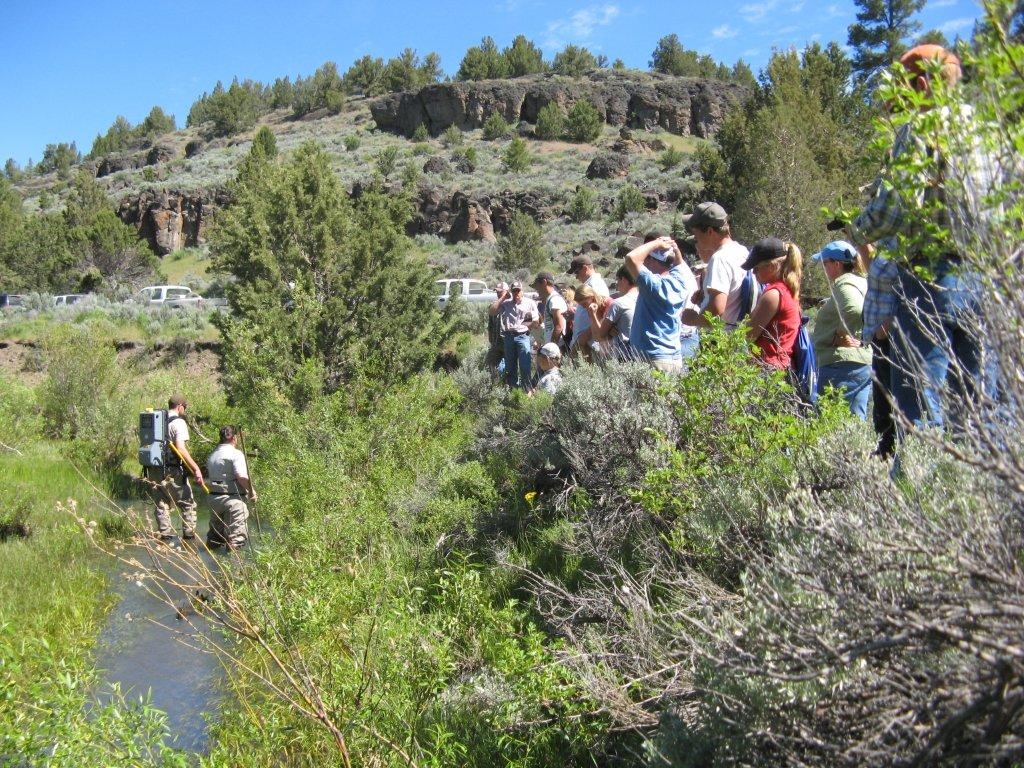
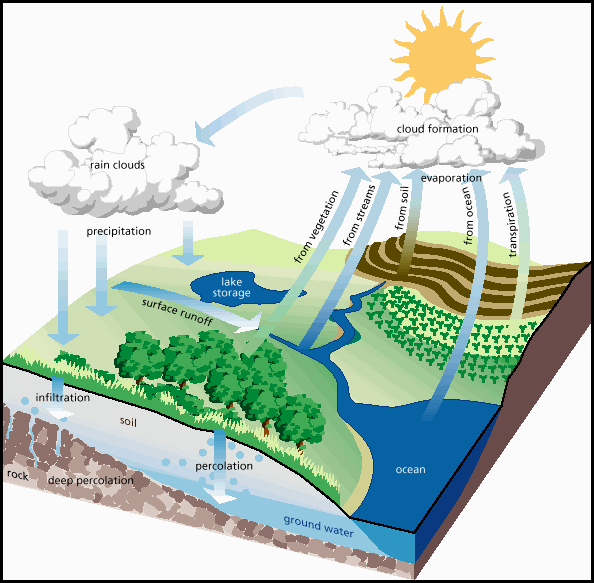
Thursday, we were at the Kerr Wildlife Management Area where we learned all about the water cycle and how vegetative cover on rangeland impacts everything from evapotranspiration to infiltration rates. We rained on plots, measured soil temps, infiltration, aggregate stability and watched various brush species waste water right before our very eyes. We swam in the spring fed Johnson Creek (awesomely beautiful) and worked on our notebooks which were due that evening. We finished off the day with snacks and a quiz bowl competition that ran past midnight!

Friday morning we did ranch plans, compiling all the knowledge we gained throughout the week. We presented our plans and gathered our things to return home. Closing ceremonies Friday afternoon included recognition for the cleanest cabin, leaders in our cabin groups, champion recreational group, best plant collections and notebooks, the Sam Coleman Award for combined notebook and plant collection achievement and the coveted Trail Boss award.

Woven throughout the week was the concept of stewardship. Directors presented the origins of the word stewardship and the biblical reasons we are called to learn to care for the land and the animals.

Plans are already underway for the 2012 Youth Range Workshop!

Have you attended or helped organize a range camp? What was your experience like?

Wednesday, July 6, 2011

High Desert Youth Range Camp Celebrates 1st Successful Year!

By Brenda Smith, Pacific Northwest Section


Group Photo

An extraordinary tradition that has been dormant for many years was renewed when 16 high-school age students from across Oregon and Idaho gathered June 19th-23rd for the first annual High Desert Youth Range Camp at the Northern Great Basin Experimental Range (NGBER) 40 miles west of Burns, OR. Well over a year ago a range camp committee made up of ARS scientists, Oregon State Cooperative Extension specialists, Treasure Valley Community College instructors and Harney County school district science teachers organized to develop the curriculum and logistics to host the camp at the 16,000 acre rangeland owned by the USDA-ARS. All told volunteers from nine agencies and local ranches committed their expertise and time as camp counselors, instructors, cooks to direct activities for the 4 day camp. The camp staff and presenters were all absolutely outstanding and put a tremendous amount of work and sacrifice to make range camp in Oregon a reality. The Pacific Northwest Section of SRM board of directors was instrumental in supporting the camp and provided a substantial financial donation to see range camp get off to a good start. A number of conservation districts and even private ranchers supported scholarships for students to attend.

Riparian Studies
Top of the World (or a Butte)

Activities included map reading, GPS, compass and orienteering, soils investigation activities, plant identification and monitoring, interactions of fire, grazing and weeds, Juniper woodland investigations, wildlife presentations on mule deer and sage grouse, a visit to the nearby Hotchkiss Co. Ranch, riparian zone investigations, student team presentations, daily team building and leadership activities, and more. The students in attendance were interested, engaged, and adventurous and worked extremely well together. It was a downright “fun” learning experience. The top student selected to attend the SRM High School youth forum is Isaac Studtmann from Long Creek, OR. Just a few of the comments received from the students include “I feel that I have taken so much out of this camp and could see myself working in this field”, “I feel so much more informed about issues with rangeland management. I am now considering a career in rangeland management much more now!” and “Overall I think camp went very well and I am happy I came. Thanks for doing this for us.”

Soil tests
We all are very excited to have a range camp back in Oregon and look forward to keeping the renewed tradition going and growing.

Wednesday, June 29, 2011

Ethnobotany: An interesting perspective on range management, at a bombing range.

By: J. Johansen, SRM Student Member

Ethnobotany: the study of how a culture uses plants. But, who cares about plants anyway? Let alone knows their names, their relationships to each other and other living things? Aren’t all those cultures dead? I find it interesting that the American sub-culture of the range manager may be one of the few who still speak the language of plants.

Range Manager, or Plant Magician?
 On this year’s Pacific Northwest Summer Tour we got a real treat, a trip through the Yakima Training Center, the US Army’s live-fire training grounds. Our gracious host shared with us his job of keeping the soil on the ground, in spite of tanks, artillery, and fires. He guided us through test plots of grasses and shrubs planted in the late 90’s, describing how each had faired over time, and how well they stood up to the abuse of army vehicles driving over them. The test plots were really interesting, in that it could be seen what plants had failed completely, what plants wandered out of their row, what plants grew larger at the edge of their plot to try and outcompete it’s neighbor, and just the chance to work on identification. The YTC’s Botanist consultant set me strait that the “two” grasses I had were in fact the same, one just had a fungal infection (don’t worry, cheatgrass!). Also, in another area towards the end of our YTC tour, we looked at a test plot from 1961.


SRMer's speak the language of plants
Land destroyed by wildfire!

In this area we looked at the after effects of a wildfire and sage seedlings that had been planted last fall. The grasses and massive amounts of lupines in this photo and all throughout the burn area had come back on there own, without seeding. The sage seedlings were planted because a large portion of the burn was within a Sage Grouse protection area (yes, on a bombing range) and they wanted the sagebrush to return.

Intact sagebrush system with previously burned hill behind

We also visited sites outside the YTC grazed by the Martinez family’s bands of sheep. One of the Principals of the largest sheep operation in the state of Washington, Mark Martinez was generous to take time out of his day, show us several sites and discus the ins and outs of running seven bands of about 7,500 sheep total.

*** J. Johansen will be attending OSU’s Range program at Eastern Oregon University for his junior year this fall, is working as a NRCS student intern, and has no credibility whatsoever. You can take a peek at what he does in his spare time at http://www.rideherd.com.

Thursday, June 16, 2011

Interest Piece: Native American uses and management of California's grasslands

By Maggie Haseman, SRM Outreach Intern

I recently read an absorbing chapter by M. Kat Anderson titled, “Native American uses and management of California’s grasslands” in the book California Grassland: Ecology and Management (2007). I am intrigued by the many ways humans have historically used plants and thought this chapter about California grasslands was a good example and a note-worthy read.

Native tribes had many uses for the plants found in California’s grasslands. The California area is unique due to its Mediterranean climate; because of this many plants in the region are endemic. Anderson’s chapter outlines how California grassland plants were used for clothing, basketry, construction materials, cordage, medicine and food.

I found it interesting to read about the various clothing and adornments the natives created from plants. For festivals, dances and ceremonies, tribes such as the Tongva and Yokut often wove wildflowers, such as cluster-lilies (Brodiaea), triplet lilies (Triteleia), dicks (Dichelostemma), iris (Iris douglasiana), and common monkeyflower (Mimulus guttatus), into their hair, and to wear in wreaths, crowns and boas. The Sierra Miwok used sleepy catchfly (Silene antirrhina) for dying face paints and wore the flowers of the non-native quaking grass (Briza humilis) in pierced-ears. The Chukchansi Yokut used an unidentified grass they called chulochul to make the front side of women’s skirts and the Wintu made regalia out of grass mat, willow (Salix) sticks, flowers and feathers.


Photo from:
Eastern California Museum
 I was particularly interested in the section regarding the arts of basketry and cordage, or rope making, both of which are old crafts dating to 10,000 years ago in western North America. Anderson outlines how plants such as alkali sacaton (Sporobolus airoides),which was widespread throughout the region, bracken fern (Pteridium aquilinum), which was prized for the black rhizomes, and deergrass (Muhlenbergia rigens), which swells in water helping to make baskets water tight were all once used to make baskets. The chapter lists some popular choices for cordage included: throughout California, dogbane (Apocynum cannabinum); in central California the milkweeds (Asclepias); in the northeastern part of the states irises (Iris); and in the southern deserts yucca (Yucca) and agave (Agave).

Also interesting was the use of plants, especially grasses, in the construction of structures and furniture. The Yana, Wappo, Owens Valley and Mono Lake Paiute, Cahuilla, Salinan, Pomo, Modoc, Klamath and Chumash thatched various structures with grasses such as giant wildrye (Leymus condensatus) and California fescue (Festuca californica) Anderson tells us the Pomo created beds by digging a hole, filling the hole with dry grass and covering the grass with tule, mats and/or skin blankets. She also notes that the Michahai and Chukaimina Yokut snake doctors made cages to carry rattlesnakes in, of an unidentified twined stiff grass.

The subject I found most fascinating were the extensive practices cited by the author for medicinal needs. The use of plants for medicine was widespread throughout California tribes. The Kumeyaay made tea for cramps from the leaves of sanicle (Sanicula arguta), the new shoots of giant wildrye were made into a tea by the Chumash to treat venereal disease, the Pomo induced sleep using dried and powdered red larkspur (Delphinium nudicaule), and the Coast Miwok made the roots of the blue-eyed-grass (Sisyrinchium bellum) into a tea to heal stomachaches. Anderson highlights the common yarrow (Achillea millefolium) as the most versatile medicinal plants used by the Ohlone, Yokeya Pomo, Washoe, Hupa, Karuk, Yurok, and Tolowa for teas, decoctions, powders, infusions, and cool or warm presses. The common yarrow was used for washing sores, alleviating toothaches, stomachaches, and headaches, treating burns, chills, fever, and sore eyes, and preventing swelling, and colds.

Perhaps the most prominent use of plants in California was for food; Anderson cited that 60-70% of nourishment for Californian tribes was derived from plants; not including the use of plants for seasoning such as the use of salt crystals from salt grass (Distichlis spicata). Grains, from grasses such as California brome (Bromus carinatus), Indian ricegrass (Achnatherum hymenoides), and the wildryes (Elymus) and seeds from wilflowers including mules-ears (Wyethia), clarkias (Clarkia), buttercups (Ranunculus), and popcorn flower (Plagiobothrys nothofulvus) were a good source of protein. The Yokut used acorns (Quercus) as an additional source of protein. For carbohydrates, California tribes searched underground for bulbs, corms and tubers. The Pomo ate the roots of cutleaf silverpuffs (Microseris lacinata) raw with nut bread. Corms from, cluster lilies, triplet lilies and dicks, and tubers from, yampah (Perideridia), turkey pea (Sanicula tuberose), soaproot (Chlorogalum pomeridianum), and mariposa lilies (Calochortus) were eaten raw, boiled, steamed, baked or roasted. For vitamins, minerals and fibers, Anderson outlines how California tribes harvested leafy greens to eat raw, soaked, or boiled, such as clovers (Trifolium), lupines (Lupinus), and fiddlenecks (Amsinckia). The Mountain Maidu collected woolen beech (Hydrophyllum capitatum) leaves, the Ohlone harvested sun cup (Camissonia ovata) foliage; the Atsugewi gathered wild parsley (Ligusticum grayi); the Kawaiisu picked common lomatium (Lomatium utriculatum). Also popular were angelicas (Angelica), which were used as seasoning in soups, and docks (Rumex), which are higher in vitamin C than citrus juice and higher in vitamin A than carrots.

According to Anderson tribes found extensive uses for the wildflowers, grasses, sedges and ferns native to California; the plants succored, fed, sheltered, and clothed the Native Americans for thousands of years. This article was very informative about the uses of plants native to California, I personally can’t wait to get out there and test some of these ancient customs. For more information or to read this chapter in its entirety, here is the citation:

Anderson, M.K. (2007). Native American uses and management of California’s grasslands. In M.R. Stromberg, J.D. Corbin & C. D’Antonio (Eds.), California grasslands: ecology and management. (pp. 57-69) Berkley, CA: University of California Press

Friday, June 10, 2011

Member Renewals and SRM on Twitter

SRM is on Twitter, a website where users can "tweet" quick, 140 character max, sentences on a variety of subject matter. SRM will be using this social networking site as another tool to get as many rangeland-related reports and information to our members as possible. Follow us to find out all the important upcoming events at a glance.

Member renewals are in full swing! Be sure to renew so you don't miss out on the latest news in rangelands. Direct questions to the SRM business office phone: (785) 843-1234 and ask for "SRM." Or email: SRM@allenpress.com. If it is after hours, please reference "SRM" in the voicemail box and leave your contact information.

Friday, June 3, 2011

SRM Welcomes Maggie Haseman, SRM Summer Outreach Intern

Maggie Haseman, tired after a long hike to our campsite on a father-daughter backpacking trip to Crater Lake in July 2010
Hi SRM, my name is Maggie Haseman and I am the new Outreach Intern here at the SRM office in Wheatridge, Colorado.  I will be a senior at Colorado State University in the fall.  I am working toward a Bachelor of Science Degree in rangeland ecology with a concentration in restoration ecology and a minor in global environmental sustainability.  After I graduate, I want to get a Master’s Degree in ethnobotany, the study of the relationship between plants and humans.  Eventually I would also like to go to law school and study environmental law.

I have lived in colorful Colorado all my life and am currently living in Fort Collins, CO.  I enjoy many activities such as hiking in the beautiful Rocky Mountains and playing the ukulele.  I also play tennis, when I get the chance, and spend time playing cards or board games, and chatting with my friends and family.

I am a first-year SRM member and heartily enjoyed attending the SRM Annual Meeting in Billings last February, where I competed in the plant ID competition.  I am very happy to have the chance to get more involved in the society through this summer Internship Program.  You will hear from me often on the SRM Outreach Blog, Facebook page and LinkedIn group until August when I must go back to school.

As the Outreach Intern I have been working on various projects for SRM including helping with the details for the 2012 Annual Meeting in Spokane, Washington, and organizing a meeting contact list so that the Society can be more efficient and organized about contacting parites for news and events related to the Annual Meeting.  I plan on using my experience at SRM and my interests in both rangelands and ethnobotany to write a series of blog posts on the history of the American Great Plains.  I would like to look into the ways that humans have shaped the ranges and also how the ranges have shaped us.